Those Flashing Ellipses

After my column was printed last week I put the longer version up on my website, went to bed, and the next morning woke up to find discussion had kicked off while I was sleeping. It’s the column equivalent of waking up after a party to find strange people crashed out in your lounge. Over the next three days the response to the column gathered such a tornado around it that I had to stop looking at my phone because it was making me go blinky.

The column was about how common female assault is. It was my two-penneth on Trump and the Not Okay campaign that has been taking the world by storm. I knew from experience that venturing admissions about your own life, especially things you normally keep quiet, often whips up debate, but I was not quite expecting my whole week to turn to the reading of and replying to countless women who saw my small contribution on the subject as a chance to share their own experiences. Writing a column is an honour at any time, but at times like this it can be positively dizzying. People give you a part of their lives, and you care for that small precious part with that slightly clammy anxiety you reserve for when you hold someone’s baby or look after their pet.

Mostly the response was loving and supportive. But there was the odd unhelpful contribution from contrary corners. There were a few men who tried to write jokey responses which landed like a wet towel on a tile floor, but most of the time it’s easier just to be gracious about their intent than it is to be grumpy that they should have just tried harder to articulate what they actually felt. You wish they knew their words are as important as any.

I spent a long time talking one evening to one of my dearest friends who had ventured onto Facebook to politely tell someone that she thought he was mansplaining my own column to me. He had taken offence, and a woman had defended him in language I would not have expected towards another woman on a subject such as assault. It got a bit ugly. I read it late one night with a glass of wine after talking to my friend, and though I felt savage that she was hurt, I dutifully spent a good while afterwards writing a diplomatic reply to all who had got caught up in the back-and-forth that was largely pointless given we were all agreeing on the same point; sexual assault is wrong.

I am always stunned to see how many people are so quick to lash out at people online. I usually bite my lip and observe and in my head is a furious dance of baffled thoughts that when distilled into sense sounds like “If you were outwardly nicer, you would be so much happier. Stop being such a horrible drag; there is so much more in you; and you have way more control over things than you think.”

Don’t fight the internet, my friend said wearily, a bit bruised. You will never win. I wanted to say I would never try. Sometimes I can’t even fight my way into a jar of gherkins, I’m hardly going to prevail against the worldwide web. It’s bloody massive, unlike a jar of gherkins (apart from those ones from Aldi; they’re ridiculous. You could gestate a baby to fullterm in those and still have room for all the gherkins of the world.) You want to unscrew the internet, you’re going to have to develop other nifty moves besides a solid leftward rotation. You’re going to have to float like a butterfly, sting like a bee, and a thousand other cognitive contortionist word bends besides. And you will still fail. Because the internet is still the internet. And people are still just people.

As the gust around the column died down to a breeze, a few leaves continued to blow in from different corners. Friends who had just read it, sending love or support or the kind of “Fuck yeah, sister, right on” that makes you feel like it’s the seventies and your bum looks good in flares.

A friend on the other side of the world then wrote to say she’d liked the piece, and that resulted in us not talking about any of the issues in the column, but in catching up on other things. Life. She is one of the best humans I know, I don’t see her nearly enough. She had just written a piece for the Guardian on Art that made me laugh and think, and told me she is turning the inside of her shed into a replica of a chapel in Padua because the chapel is so beautiful, and also because, why not. I asked her which chapel, as though I knew anything about any of the chapels in Padua. Cue an accompanying photo of a domed chapel ceiling of the most brilliant blue – a shade she’d have a better name for – all stuck over with gold stars and sloping down into the usual array of fucked up be-robed beautiful martyrs I’ve never heard of but that she could bring to life with  historical anecdotes; her wit is the scrubbed-up gilt on faded art. With one fired out little picture on my phone I loved her a little more.

We talked in that stretched out way you do, typing a reply then coming back moments later to see those flashing ellipses, letting you know the other person is typing. Is there a nicer modern feeling than seeing someone you like is typing, knowing that soon you will be able to read their reply, and while you are waiting you have that warm glow of knowing that whatever they say will make you smile. That they’re not total dicks who will blindside you with buffoonery. You trust in the joy of them being them, whatever their mood.

And so a week of word torrents quietened down to my friend telling me about her first batch of sweet peas in Melbourne while I hung out my washing and hoped it wouldn’t rain, imagining the smell of her real flowers alongside the fake orchid fragrance of my fresh bedsheets. Holding her beside me in my palm, that ambidextrous living we have evolved to accommodate the appendage of our phones, this transglobal togetherness we are now so casual about. Our chat sprawled over hours; I bookended her sleep, she bookended my day. Pictures of flowers and dogs and paintings (hers) and silly gifs (mine) and quietly ventured thoughts. A youtube clip of a beautiful song that stilled me to silence acted as a perfect epilogue. A casual cheerio til next time. The internet had been used as a pallet, a picture book, a toy box, a jukebox, a photo album, and as written notes that would have otherwise taken weeks to pass between us without the speed of the ether. It was a good bit of internetting. It was satisfying, illuminating, funny, warm, with no agenda but its own simplicity, and it made my heart bounce.

Sometimes when you run from the jungle, there are tendrils that wind their way to find you out in the clearing. Sometimes the internet can make you cry with its overwhelming too-big power, and sometimes it allows you to see sweet peas in a friend’s garden on the other side of the world.


Screen Shot 2016-10-19 at 19.43.12.png

Cornelius

Trimmed from the book: a little story about an old neighbour of mine… (his name has been changed)…


2004, or thereabouts

 One night. Just after midnight.


I wasn’t quite asleep. My book kept falling from my fingers, doinking onto my chin as I dozed off, and Dickhead was deep in some wanker’s reworking of a homoerotic Greek battle. I was thrusting my big toes down the side of my socks to lazily pull them off without using my hands, when the doorbell rang. I popped open an eye and glanced at Dick. Late night bells, knocks and noises were Man territory right? Nothing. Nary a glimmer of cognition. Some spartans were probably charging an armoured mammoth with their cocks flapping in the wind.

I shut my eye and ignored it. The bell rang again. I popped open my eye, this time with a hinty exhalation. Nothing. Perineum Maximillius Vibrillicious, son to a slain king and dildo to a serpent’s gash, was probably avenging something mighty on a hill, his pecs shining with the crusted jizz of Achilles or something. I kicked my feet out of the bed with a sigh and went over to the window, always forgetting that you couldn’t see who was standing at the door if they didn’t step back far enough; they were always shielded by the porch gable. The bell rang again.

“Who the fuck is that?”, Dick popped a reluctant response out of his sagging bedmouth, never once taking his eyes off a passage involving olive-oiled Athenian whores, twin shishtas Donner and Kleftico, pole-dancing around bloody spears spiked into the newly-felled corpse of Ancient Greece’s last known lesser-spotted bald-twatted spearmint rhino or whatever.

Again, the ringing bell. I grabbed my dressing gown and pulled it on while huffing and muttering under my breath. “I’ll go then, shall I?”

I left him squinting emotionally over the bit where Socrates wanks off an argonaut with a pitta-bread and went downstairs to open the door. I was actually a bit too annoyed at the lateness of the visit to feel nervous about who it might be and for what. A small wondering flashed through me. “Wonder if someone’s topped themselves.” (It’s always there.)

It was Cornelius. The old dude who lived next door at 56. Totally alive. He stood in his grey dressing gown beneath which I could see the stripes of traditional pyjamas, his black skin silvery grey in the moonlight and his eyes like scorched lanterns. He looked like a Cayenne Jacob Marley come to tell me ghosts were on their way. Cornelius was from Guyana and spoke in a soft Jamaican twang with curious French serifs. I’d been making a bit of an effort with him lately as he always seemed to be outside his house painting something which didn’t need to be painted. His house was cladded and painted all sorts of greys and reds. It was vile, but impeccably vile. He was clearly very particular about it, and in his recent spate of touch-ups I had often stopped and chatted with him, our longest conversation being about half an hour on astrology while I was busting for a wee. He was a great believer in the controlling forces of the moon, and we talked of tides and how we might be controlled in some way by the moon what with being mostly water ourselves. It would have been a really lovely lunar conversation if I hadn’t been concentrating on holding in my own inner tide.

Cornelius had cute springy hair, but seemed perpetually sad like he was always suspicious that kids were about to jump out and throw bottles of piss at him. I hoped he hadn’t been broken by our country being mean to him. I tried to play a nice ambassador so he wouldn’t think we were all arseholes.

Despite our new front garden friendship, I can’t pretend I wasn’t surprised to see Cornelius standing on my doorstep at a little past midnight in his dressing gown. Holding a hammer. I wondered if he might have been sitting up pondering our cosmos chat and had had an extra thought to add. I thought he might ask me to take a walk and look at the moon with him, and amble his way through a beautiful monologue about life and the stars, of time and existence, walk into the middle of the street, pick up a stone from a pothole puddle and crack it open with the hammer, to reveal a cluster of crystal inside. That we would share a silent moment of inexorable wonder and, in an unspoken agreement, from then on each night meet under the lamppost at the witching hour and walk out along a silver ribbon of moonlight together. A dusky old man in pyjamas and a pallid robed girl, sighing for her father. Cornelius could be my new one! He could adop…

Ok. I was a bit thrown off my romance by the hammer.

“Hey, Cornelius. Everything ok?”

His eyes loomed at me like jungle fires. What on earth was wrong?

“What. Is that. Noiiise?” Every consonant was sibilant with his spittle which bubbled at his twitching lips.

“What noise, Cornelius?” I cocked my head slightly to show willing, but the night was silent.

“That noiiise. That bang-ing.”

I listened, and made an extra show of it in the hope it might assuage his vexation. He looked tortured. He looked like he didn’t recognise me. I wanted to point at the moon and say “Hey, Cornelius, remember the crystal? Come back to me.” My heart darkened. He was shaking, and the hammer was swinging in his hand by his side.

“Cornelius, I can’t hear anything.”

“Are. You bang-ing?”

“No, I’m not. I’m just about to go to sleep.”

“That bang-ing.”


His eyes widened and dragged to the side as he heard it.

There was nothing.

“Cornelius, where is it coming from? Show me, we’ll find it.”

“You are. You’re banging. Is it music? Tell me?”

“I promise, Cornelius, we’re making no noise at all, we’re reading.”

“Bang-ing.” His eyes searched the floor. His lip quivered.

“Come in if you like, see if you can hear it in here.”

He stood rooted to the spot, staring at the threshold like he had not been invited into anyone’s house for years and that it might be a trick.

“Come on Cornelius. We’ll find the noise. Show me.”

I stepped back, back into my flat and up a stair to show him it was ok.


He gingerly stepped forward and into the house, like he thought I might have scattered a line of voodoo salt at the door which would set him aflame.

I walked up the stairs, hoping he would follow me and not just take up residence as a disgruntled statue in the hallway. He slowly followed. As we walked up the stairs I tried to break the surreal awkwardness of drawing a man in his pyjamas into my flat in the middle of the night by giving him a sort of audioscope tour of the place.

“So, this bit would be presumably next to your stairs, then this bit would be your upstairs hallway, and…”

“It’s coming from the back, I can hear it.”

“Okay – so down here is my kitchen, is this where you mean?”


I led him to the kitchen. His eyes darted around it like he was trying to stab fireflies with invisible lasers. Invisible fireflies. Inaudible noise.

“What’s up?”

Dick had shuffled down the hallway to see what was going on.


“Cornelius can hear banging and we’re just trying to figure out where it’s coming from.” I tried to explain without betraying Cornelius by doing a too-obvious eye-widened ‘help me’ signal.

“I can’t hear anything.”

“No. Neither can I. Cornelius, there’s nothing here.”


Cornelius was peering at the wall that adjoined his and resisting the urge to swipe things aside to get to it. He looked defeated.

“Can you still hear it?” I wondered if the noise had abated since he’d come in.

He didn’t want to say no, I could see the struggle in his face as his eyes confided that the ears weren’t reliable, but his mouth pinched stoically in the way of the word “N…”


His eyes widened again, the whites of his eyes butter yellow in the harsh kitchen light, trails of roadmap red creeping in at the corners. He looked tired. He looked like he painted everything clean in the day then sat up to be nightwatchman over it. He needed sleep. I knew that look.

“Ok, well, I’ve got an early start, so, er, I suggest if we can’t solve it tonight we wrap it up, yeah?” Dick grunted his way back to bed.

I stood looking at Cornelius who showed no signs of having even noticed he’d had been there.

“Cornelius, can you still hear it?”

“Is your microwave on?”

“No. Look. It’s off. Look – I’ll unplug it.”


I pulled out the plug, then as a consolatory measure switched off all the plug sockets around the kitchen. My stomach flipped at the thought of explaining to Dick that the clocks needed resetting on the microwave and oven. I opened the window to indicate there was nothing coming from out there too. Then I shut it. He hadn’t even seen me do it.

“Is it still there?”

He just stood there, his face pulsing like minuscule bats were flapping beneath it. I wrung my hands and shifted my feet to try and hint I was all out of suggestions.

“I don…Cornelius, I don’t know what to do.”

His helplessness was agonising. But I had to get him out somehow because he was lost in something that hours of joint puzzling would never wrest him from.

“Ok. Let me come back with you – show me where it’s coming from. Cornelius? Come on. Let’s go.” I tried to usher him with my body.


He eventually came with me. I led him all the way down the stairs, into the hallway, putting on both latches and pulling the doors to, out into the garden, around the fence, and came to a stop in front of his door. I felt vaguely ludicrous being outside in my dressing gown and pyjamas but didn’t have time to time to develop the embarrassment. He opened his door and I followed him inside.

It was immaculate. It was like a museum of the 70s. It smelled of paint and that strange stale smell that hoovers get when the bags are nearing full. I glanced through to the lounge – it looked like no one ever went in there. If I could have scratched at a corner I could have peeled off a film of cellophane from the whole room. Browns and mustards and golds. The dining room door was shut. Down the hall the kitchen, as briefly as I glimpsed it, had those little touches that showed it had once been a woman’s room, but that the woman was now gone and the man was trying to keep it all exactly the same.

I followed him up the stairs, where the condition of the place changed. The wallpaper was faded and peeling, there were patches of plaster peeking through in the corners, and the doors were scuffed and dirty. It was narrow up there. I felt hemmed in. I was standing in my nightwear in a strange man’s house. Don’t let it feel odd, Daisy. Not yet. Wallow in the weirdness once you’re out, but for now stay focused.

He led me into his bedroom. I swallowed some spit down to stop my throat from clagging.


Oh. Sweet. Jesus.


There were crucifixes everywhere. There must have been five or six on each wall, banged up in haphazard disarray. Some were gold-painted plastic with little droopy-necked Jesuses and some were puritan wooden crosses. Almost all were wonky.


I swallowed hard. I don’t know why that room should have been more chilling displaying the worldwide symbol of goodness, purity and martyrdom than without, but it set my heart flapping like a trapped pigeon. Glowing portraits of Satan would have been only slightly more unsettling.

I breathed deep and reminded myself that Cornelius was perfectly harmless, that he was distressed, and I was there to try and help him.

“There it is!” He was victorious, his eyes pierced me as he suddenly stepped back into the moment. There was no noise. Nothing. Just the ticking of a clock on the wall.

“Where?”

“Can. You. Not. Hear iiit?” He was livid with me for asking again.

“Cornelius, I’m so sorry, I can’t. Point it out to me.”


He darted over to the alcove beside the fireplace, which must have been where the microwave in my kitchen was. My heart leapt with hope. It tallied with where he thought the noise was in my place. We might find the noise, if it’s there. My eyes followed him over and I took in the rest of the room.

There was a single bed, with a bedspread pulled so tightly over it I think it would have cracked if you’d sat on it. A bedside table with a lamp and a tiny alarm clock. The crucifixes. A wall clock, ticking. On the mantelpiece was another clock, ticking. On a nearby shelf was a pristinely set row of ancient bottles of aftershave, lotions and balms. On another shelf another clock, ticking.

Bloody hell, the room was reverberating with all the off-beat ticks. How could he stand it? Surely this wasn’t the noise he was talking about?

I looked at him – he was prodding away in an alcove with shelves built in which had been covered by a hanging brown blanket.

“It’s here. Bang-ing. Can you hear it? It’s going wheeeeeee. Wheeeeee. Wheeeeeee.”

He squeezed his eyes shut as he pitched his voice up to demonstrate what was clearly not a banging noise but a screeching, and I stared at his greyblack face and felt a crippling combination of pity and fear.

“It’s going wheeeeeeeeeee and it’s driiiv-ing me mad. It’s driiv-ing me maad.”

His eyes opened wide and found me, implored me. I dragged my eyes from his over to the door to see if it was still open, and as I did I saw that the alcove shelves were stuffed tight with blankets and sheets. The fireplace was stuffed tight with blankets and sheets. The other alcove shelves were stuffed tight with blankets and sheets. This man had tried to soundproof his room. There was no sound but the ticking of those infernal clocks. But he did not mean the clocks. He was scratching and scrabbling around the wall like a maddened rat. I hate that my self-preservation kicked in in such a cliched way when this man was clearly distressed and had absolutely no interest in me as a woman with recessive parts or as a recipient of violence, whatsoever, but an ice passed through me and I knew I had to get out. I was standing in my pyjamas in a room so searingly sad and odd with a man also in his pyjamas holding a hammer past midnight on a school night. I needed to live, but more than that I needed to sleep, because I had 9D in the morning and they were little cunts.

“Cornelius. I am so so sorry, but I really cannot hear anything. I must go to bed, but please let me know if you can still hear it tomorrow when I get in from work and I promise you we’ll get to the bottom of it. Maybe my hearing’s just rubbish.”

He stood staring at the floor.

“Cornelius, I know it’s hard, but try to get to sleep and we’ll talk tomorrow. I promise.

I moved away, down the hallway, down the stairs and to the front door, by which point I had stopped panicking. If he had wanted to stop me, he would have by now. He was suddenly behind me as I opened the door and I stood on his step and smiled back at him.

“We’ll talk tomorrow, Cornelius – okay?”

He nodded distractedly and flicked his eyes up and down the street with his usual suspicion and closed the door without a word. The hallway light flicked off.


I went back into the flat, shut the doors, fastened the deadbolt, and went back to bed.

“Did you sort it?” Dick mumbled from behind his book.

“No. I went into his house and couldn’t hear a thing. Do you think he’s mad?”

“No, but you are. You could have got raped.”

“He was distressed, not horny. It was horrible. I didn’t know what to do – there was no noise at all.”

“Well, just don’t go in there again, and don’t let him in here, and it’ll be fine.”

And that was that. He went back to Aphrodite firing olives from her minge into a minotaur’s mouth, and I went to sleep, eventually.


I didn’t hear from Cornelius the next day. I rang on the bell after school, but there was no answer. A few days later I had a note through my door telling me the banging was back and to call him. I called his landline and he was mildly abusive to me, saying he wished I would stop torturing him. I tried my hardest to convince him that there was absolutely nothing my side causing a noise, but he wouldn’t believe me. I suppose it was easier to think I was behaving maliciously than to think he was going a bit mad. It hurt, but I had to leave it there. There was nothing I could do.

I saw him only a few times after this, pottering outside his house, but he never busied himself like he used to, and saying hello was always strained and sad. No more talks of constellations or the moon. I got the same suspicious looks reserved for strangers.

Since being back, next door but one, I have never seen him. I guess he’s still there. There’s still his awful gaudy cladding, still his net curtains. But I’ve never seen him go in, and I’ve never seen him come out. And I’ve never seen a light on when it’s dark outside.


 

screen-shot-2016-10-18-at-19-46-51


“Grab that Pussy” / Not Okay

I’ve struggled a bit with the column I wrote last week. It was ostensibly about Green Rooms, but towards the end, unplanned, I wrote about an incident where my bottom got touched by a man in a pub. It was a small incident. It didn’t bother me terribly, I didn’t feel intimidated, and I have no bad feeling towards the man who touched it. The thing that niggled me afterwards was my own reaction. That once I had allowed myself to admit that it was ‘a bit off’ touching a woman’s behind (and not just the rump, but the jackpot) I then felt bad. I felt like because I hadn’t made a fuss about it on the spot, because I had continued to sit and talk to him afterwards as though the arsecrack-fingering had been a mere accidental brush, that I had lost my right to say that it had happened at all. I felt rude, like I might offend him by writing about it. I felt guilty, like drawing attention to it might reduce me to some hideous screaming woman, making a needless fuss about a non-thing. And then, later, even more worryingly, I worked my way through that damaging litany of self-attacks that women can turn upon themselves. I thought “Don’t make a fuss about it because you’ll look like you’re drawing attention to yourself and people will take one look at you and think “Ugh. Who would want you?” Women do that. That is a standard progression of thought for a lot of women. Don’t make a fuss about having your bum touched because people will just look at your bum and think “you should be grateful anyone wanted to touch that, love.”

So I struggled with that. And I shouldn’t have done. I know that much.

If he had done it to a friend I would have been furious. If I’d seen it happen to a female in a pub I’d have to be held back from making things ‘uncomfortable for all’, especially if I’d had a fortifying beer or two – I’ve had a man against a wall by the throat for calling a friend a bitch before – but because it was ‘just me’ I feel, even now, writing this semi-apology semi-excusal of my column, that I am expounding far too many words on something that should just be left to slide away in silence. Perhaps I am not very good at protecting myself. Perhaps I feel like I don’t deserve the respect that I would demand for other women.

Meanwhile, in the bigger more important world, Donald Trump had his campaign seriously damaged when some old news drifted up from the buried flotsam of his life. A 2005 tape of him boasting that he just leans in and kisses any woman he likes, that he can get away with anything, and that grabbing a woman’s pudendum is his entitlement and that they’re not going to do anything about it because he is him.

I’m not sure what’s worse – the inference that he is special and women can’t say no to him because of his money and power, or that any man could be a similar winner in sexual situations if only he just had the balls to take it by force. Women appear to be even lower in his rank of respect than stocks; at least those you have to pay for. Women you can just take, right? “Grab that pussy.”

Meanwhile on Twitter, an LA writer named Kelly Oxford waged a powerful attack on female sexual assault with her campaign #NotOkay. She posted details of her own sexual assault and asked other women to follow suit. To share their stories, to speak out. It is not an easy thing to do for anyone, ever, but ten million stories later and growing, it seems clear that a lot of women were grateful for the encouragement, and the platform, the audience, and the recognition.

Perhaps something in seeing a woman as strong as Hillary Clinton being corralled by the bully-boy power-prowling in the dirty war for the presidency brought something out in us too. A collective courage. Fire. A female complicity. Sisterhood. Even Hillary Clinton, potential president of the United States of America, was not being graced with respect. Her stature as a woman and a wife was being wrestled to the mud; the inference being not that her husband wasn’t a good enough man, but that she wasn’t a good enough wife to make him want to be a better man. Even Trump isn’t stupid enough to say “maybe you just didn’t put out enough, Hills” but we all know his thoughts are not far off that level of sophistication, if not worse. God knows what his actual inner monologue is. Where George Bush’s would have been the aural equivalent of tumbleweed scrubbing up against barbed-wire, Trump’s must be a circle of Hell’s worth of machismo and pussy-pummelling misogyny that would burn a tape to cinders should you try to record it for presidential posterity.

Anger flared up in me as I watched Trump parade his besuited cock around with menacing arrogance, his loathsome grimace as hard as a Mount Rushmore forefather, and anger raged around me as I read the unending stream of women’s brief history of common assault. Each story reduced to the 140 characters of a standard tweet. The editorial brevity of those heinous everyday wrongdoings packed a powerful punch. Millions of them. Millions. In a day. Just one day. Millions. They were all out there these women, waiting to speak.

I felt the hot rush of tears as I read them, remembering all the times I have been forced into a situation, all the times I have been touched or pushed or stuck in a corner. In stealth on a busy platform or tube or corridor, blatantly in open space, on beds, in doorways, or casually in social situations. Throat grabbed, hair pulled, knees between my thighs, hands between my legs, fingers up my arse. Trapped in a car seat. My face held between thumb and forefinger, pulled towards their face, seemingly saying “I dare you to stop me”. Told I know I “want it”, even after I have said no, even when I have been on the brink of tears. All the times I have bucked or talked or faux-laughed my way out of a situation, ever polite, and then ‘felt bad’ and never made a fuss. What a good girl. I think it has taken me years – I do mean years; right up to the present day – to fully properly accept that it is wrong. It is wrong for anyone to be treated like this by anyone in any place at any time; wrong. And I am still not strong enough to turn around and smack someone down in my own defence. Because it is scary being a woman. Sometimes it is wonderful. But sometimes it is scary. It really sometimes is.

So I tweeted my own 140 character list of assaults I’ve experienced over the years, a mere random selection typed out in about thirty seconds to join the others. While typing it I felt dirty and guilty and stupid, like I had brought it all on myself, that retrospectively chronicling such a list was somehow trying to invoke old spirits, a ouija board of pointless accusals, that the brevity of a tweet was in itself a disrespectful handling of a subject that affects many women far worse, that my contribution was not helpful to any cause, and that voicing it was the social networking equivalent of running around the streets in a negligee, tits flapping about while squealing “don’t look at my tits”. I nearly deleted it about fifty times. But a while afterwards, leaving it out there, I felt stronger knowing it was out there, joining the ranks of others, most of whose suffering had been far worse than my own admissions.

But.

But I’m still feeling timid and apologetic writing this. I still feel guilty and a bit stupid. I feel a flush of shame for knowing it has been printed and that I am now, as I must, posting it. And that means we just have to keep going, being that open, feeling that anger, letting others know that they are not alone, that it is not freak occurrences but every day – every day – and that it is not okay. It is not okay. And we have to keep acting like we know it is not okay. Every day. And feel the sisterhood of millions beside us if we need to, because they are there.


screen-shot-2016-10-12-at-22-46-03

Green Room Games

Green rooms are intriguing places. Not least because no one knows why they’re called green rooms. Or at least, I don’t. I don’t know why they’re called green rooms. 

A quick google might throw up some etymological gems as to why they are called Green Rooms. Perhaps they are named after Restoration actor Fortescue Green, who had a boil so big it commanded its own seat in the tavern, which was mercifully lanced in the half of a best-forgotten Congreve in 1823 by actor & gout martyr John Archibald to the great relief of Fortescue but to the ruination of the theatre’s soft furnishings. In Windermere or somewhere. Perhaps no one ever went in that pungent room again. “Venture ye not forth into ‘the Green Room’. The stubborn malodorous pus make of it a treacherous place.” Perhaps it’s that or something. I imagine it is. I’ll google it later.

Anyway. They’re funny places, Green Rooms. Anywhere where humans hang out and wait are a bit odd. Railway platforms. Doctor’s surgeries. Supermarket queues. There’s just no avoiding the humans on display. It’s like compulsory theatre. You have to be there, getting the train, buying your beans, having a jab, whatever, but so do other people. There you all are, existing in the same place together, watching each other be alive. Weird.

Anyway. Green rooms are waiting rooms for actors usually. A chill-out area. A graveyard for stale old sofas, where wire coathangers flock like angular crows. The term has widened over time for anyone about to go on to some sort of stage at some sort of event. At best, a green room can be a salon of wonder, a mellow precursor to a happening – at worst it can be a holding area for big-headed flatulent fatuous charlatans with halitosis and elevated visions of their own worth to society. 

Pre-event Green Rooms have to have chairs or people get cross, & they usually have drinks and snacks because hydration is important, booze stops the alcoholics bitching and getting the shakes, & pretzels – or in hedonistic circles the occasional mini-cheddar – give you something to do with your hands. People fill their boots, sitting and drinking and eating while self-doubt churns over inside like psyche cement. Sometimes Green Rooms are nice places and make you feel special & like you’re doing a nice thing. And sometimes they make you feel penned in like a pig at market, nervously rubbing your bacon up against other idiots who would rather be at home too.

Anyway. I spent quite a lot of my time this weekend hanging out in a green room at the end of the pier. We had a weekend of music talks programmed to close Estuary Festival.

Most people were utterly charming. Erudite modest gems, happy to be there, humbled by appearing alongside other interesting people. Most either ranked themselves lower in the echelons of excellence or had the decency to pretend. I loved watching them all mingling and chatting, conversation flowing naturally like water over pebbles in a stream. I was privy to beautiful fragments, snatches of conversation about art and the state of the world as artists and writers and musicians and cultural commentators sparked quietly off each other as they waited to go on stage & do more of the same in front of their audience. I have never felt so happy to be stupid. Listening is great. Some people should shut up and listen more. I had a lovely time.

And then an artist got drunk and ventured his hand into a part of my body better acquainted with the more robust of bike seats. (I don’t cycle, but I feel this is a good highlighter for the anatomical crux of this particular anecdote.) 

A few of us had gone to the boozer after the event, and there I was, getting something out of my bag, and there this chap was, sizing me up for a tandem. And I thought to myself “There’s always one. Always one self-professed genius who ruins a nice day by trying to turn you into a hand puppet.” 

I wondered if something had gone wrong in the Green Room. Perhaps my being interested in what people had to say had, my lighting up at the people and the topics and the fleeting togetherness of us all, via a series of booze-bevelled sociological extractions, led to my arse getting used as a plug socket. Perhaps I deserved it, having those holes in the first place. Perhaps I shouldn’t make a fuss. That’s what it can feel like sometimes, being a woman. Play hostess; free game. Even writing this bit at the end of my own column feels rude. To him. That’s worrying, right?

Other than that everyone was a dream and it was a great Green room as green rooms go. 

No one ate the mini cheddars though. Very claggy.

A Crossing Bell

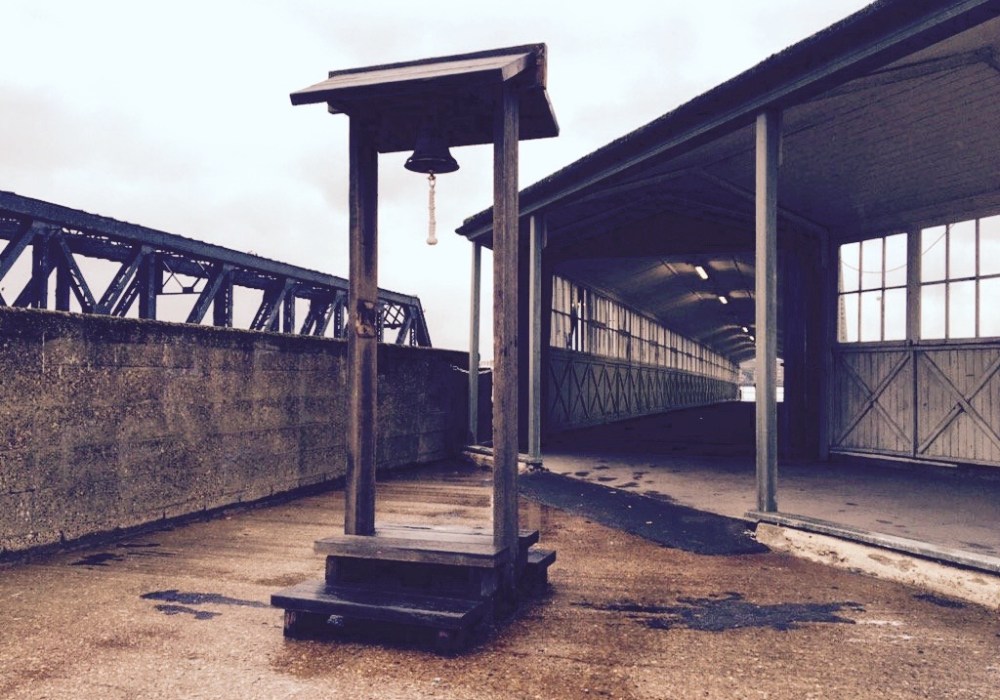
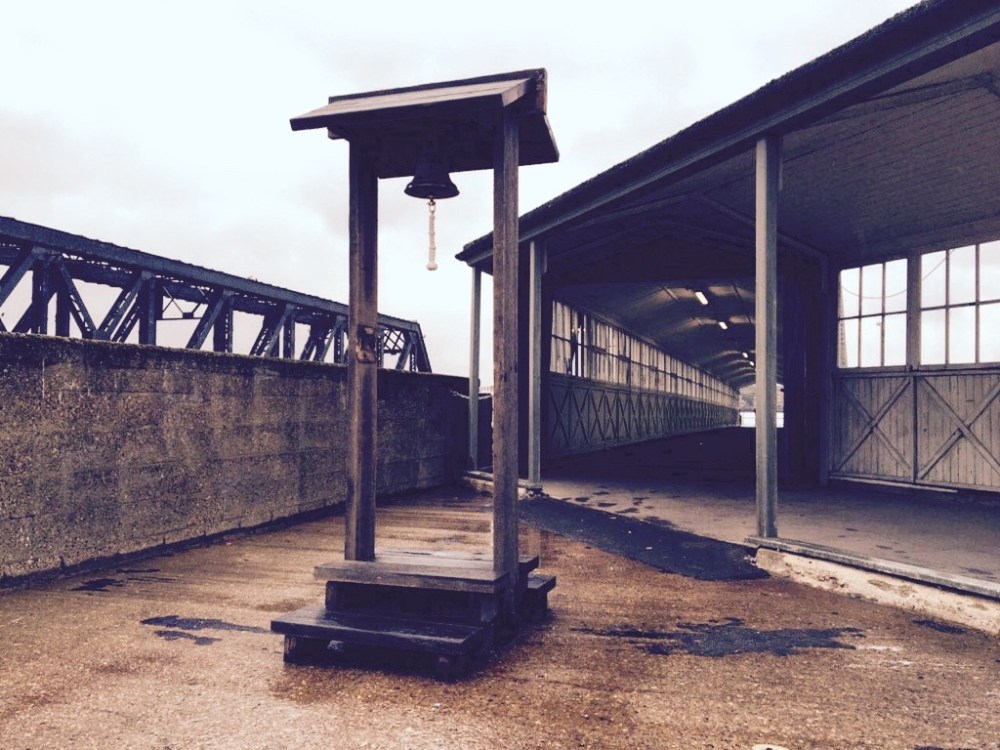
I rang the bell. I had been about to pass it, having heard it rung, mostly by children, almost constantly for the past two days. Something called me back, to approach it. Maybe it’s because no one else was around and I saw my chance. I rang it. It sounded louder than when other people rang it. I felt naughty somehow. So I rang it again. It had a clarity, as though it had found exactly the right points around it to bounce from to make itself sound important; drew them in like coordinates of the perfect pitch then sent them pealing out to the clouds.

The bell is A Crossing Bell – an art installation at Tilbury Cruise Terminal by Professor of Sound & Landscape Angus Carlyle who has worked in residence at Metal, an arts organisation with a big heart in a big house in a pretty park where I am lucky to work. He is also a part of Estuary Festival. Passengers are invited to ring the bell while offering a prayer for a crossing – their crossing or someone else’s, a friend’s or a stranger’s; a prayer to ward off the bad or wish for the good. Angus’ hope is that the bell’s unamplified peals suggest other crossings, other times and other places. And they do.

I only remembered then as I rang it that right there, down to the deck to the waters between Tilbury and Gravesend, that my dad had been moored here in the 60s. I have the last diaries he wrote as a teen in the Merchant Navy. 1964. After months of sailing more exotic waters – Biscay, Suez, Arabian Sea, Muscat, Persian Gulf, Abu Dhabi, Calcutta, Trincomalee, Colombo, his list goes on – they drifted… into Southend-on-Sea. My hometown. A strange town that Dad could not have known then would be the place he’d later move to in his fifties to be near his daughters, and then soon after where he would take his life. He stayed four days in 1964 then sailed on to Tilbury, and one night – “went ashore to dance in Gravesend with lads. Got really pissed.” The next morning, he got up at 8.15, and “just read papers all morning.” Then the diaries come to an end, and as far as I know he never wrote any others. Or certainly none that he kept and passed on. Perhaps these were the only ones that he wasn’t ashamed of. The ones that only chronicle small details of ship life – no truths of his character or feelings at all that might be of use in the puzzle of a dead bi-polar man.

I had just been thinking the week before, as I walked past the road where he lived and died, that I felt pretty cool about him being dead, now. I felt tough. Over it. Cool. I walked past – as I do most days, I live a few roads away now – and felt ‘nothing’.

But I didn’t feel nothing when I rang the bell. It was like a brass hammer to the sky, cracking open the clouds to say hullo to my father, there on the very waters where he had written in his tiny blue scrawl. Maybe only meters away from where I stood, now, ringing it. Maybe if I could call to him back then – me on the deck, him rocking in his bunk – he could have heard me. Was his ship that close? If only time could allow me that experiment. Distance and time and death. Science. What huge impassable relentlessly factual things keep people apart.

Earlier that morning I had been up at 5am for a dawn performance by a vocal artist named Caroline Bergvall, who wove her mesmeric voice with that of a vocalist Peyee Chen and a backing track of collected sounds. Raga Dawn. My job was to capture it for other people, but towards the end I just lay down on the deck behind the audience, my spine falling between one of the broad gaps in the planks, the breeze surging up through the fibres of my jumper to my skin, and the sound of the heavy lapping water beneath my head. What do we think in these moments of reflection? Our thoughts trip on to one thing mostly. To how we feel, to people, to those we have lost. To love. To loss. To death. I often wonder if anyone can ever pass truly blithely through life without thoughts of death; whether it is a dialogue that can be completely avoided. Whether the ‘mentally ill’ can shut out awareness of it with a complete efficiency that we, the ‘more normal’, the ‘well’, cannot.

I suppose it comes as a not-too-great surprise that artists are drawn to water and to death. It tells not only stories, captures our thoughts, loves, and fears, but it also inspires a sort of peace that must be made before we ourselves go. A peace with ourselves. Estuary Festival is full of work by countless artists of dizzying various disciplines that observe a similar theme, but it is this piece – A Crossing Bell – that spoke to me, because it spoke for me.

I didn’t tell Angus during our multiple chats as he milled around in a nice blue jacket that I had rung his bell and been moved. I felt shy. I don’t know why. Maybe I just wanted to keep it for myself. Between me & Dad & the river.

The bell did its job. A hullo was said. And a small patch of the Thames that was new to me became familiar, like Dad was with me for a while, strong and tangible as bronze, invisible yet potent as sound waves saying “I was here.”


Estuary Festival runs until the 2nd October in various places in Tilbury, Gravesend, and Southend. For more – go here.

For more on Angus Carlyle, go here. And the bell – here.

For Caroline Bergvall & Raga Dawn, go here.

image1-1

Poem: Grey Timebends

I wore my glasses to see it better

but there are sea mists today

that occlude ocular aids. 

Nature as boss,

as it should be.

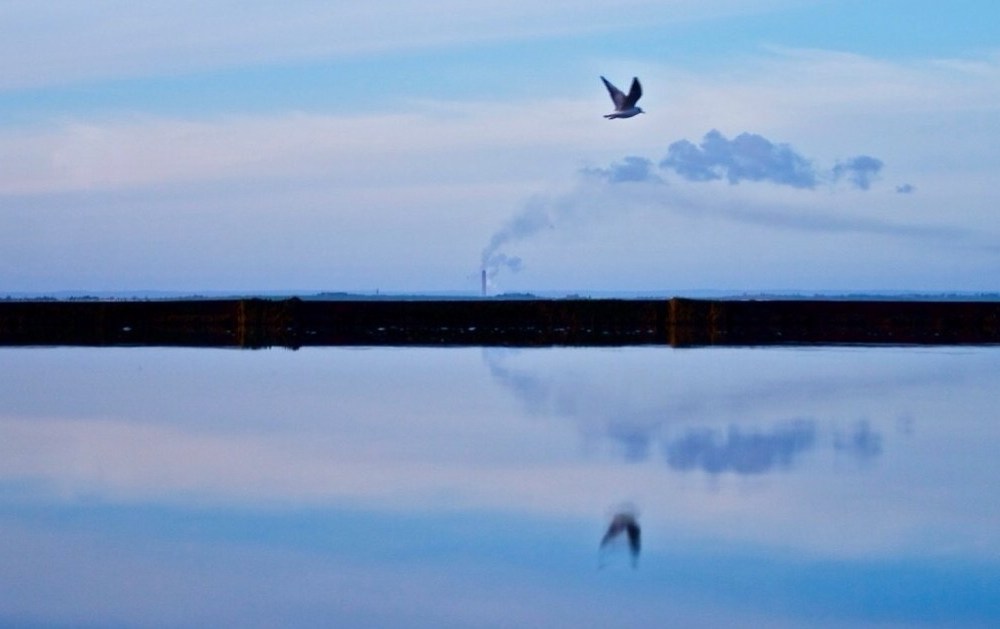
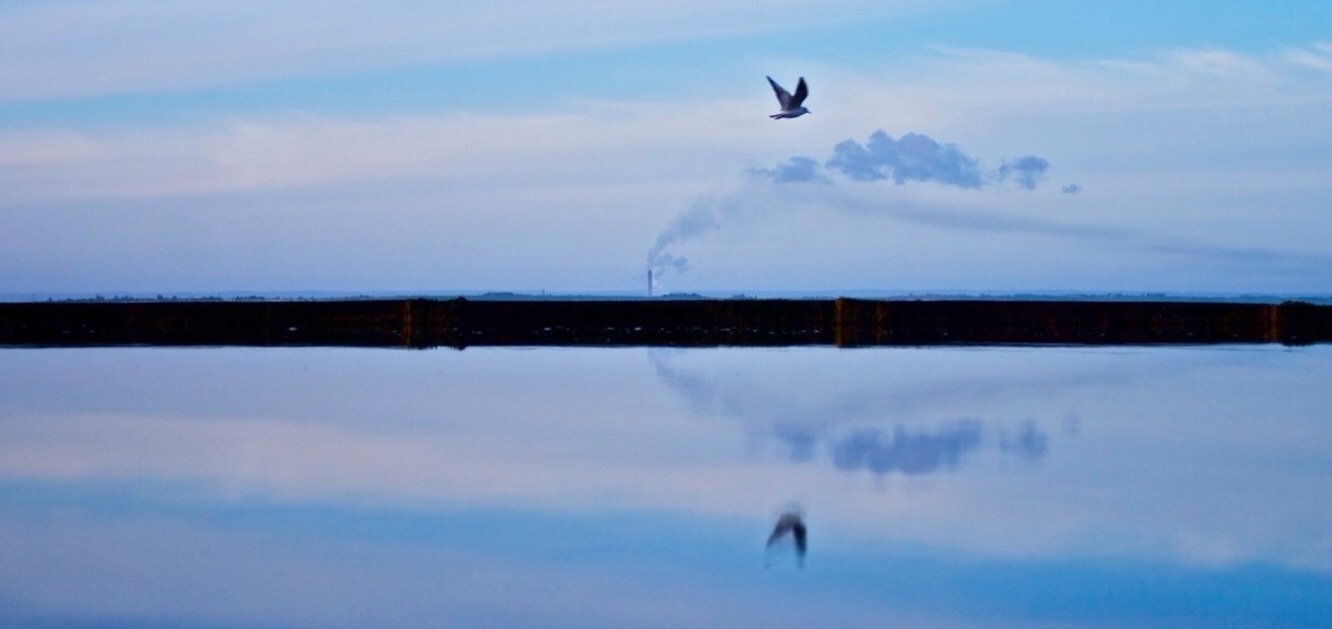
We can barely see the great chimney –

tallest man in any room –

our changing estuary did not feel like putting on a show.

The rest of the sky stayed crisp as a child’s crayon line

while the small patch set aside for devastation pulled tight

Constable’s blend, blurred hues and grey timebends.

It’s all a haze. Shy.

Seems only right

the crematorium curtains should be pulled before the smoke.

It falls.

A late blow shakes the sky.

It’s half-fallen before the thunderchime like a military gun 

Speaks up for the river,

the buried munition 

of hundreds of years of man’s wars and progressions and explosions,

dredges up the voices of the silent hulks teeming with weeds & fish & lost trinkets & buried time.

The ghosts shriek together and then are silent.

It falls.

Rubble to be settled

and moved by machines by men who want it gone.

Today. Not tomorrow.

Minutes.

Four minutes and it’s gone.

A train runs to time.

Boats glint like brass buttons in funereal mud.

Dogs turn their noses up to the drift blow and close their eyes.

People start talking again, begin to move.

Disappointed there was 

‘not more to see in an otherwise clear sky’.

Schoolchildren on a day trip to see destruction,

who will forget they ever came,

clamber back up the hill, 

their minds not even on what will be constructed there next.

Landscapes change.

This was never theirs.

Voyeurs of a part of us,

Gone.
  

life & death & secrets & sharing

I managed to find a quiet spot, in the shade of a little bush that sounded like it was whispering. Leaves that flickered in vertical half-rotations like the royal wave. Lots of people had come to the cliffs to watch the chimney get blown into the ground. There was the polite general hubbub of strangers standing together. A group of school children talked loudly and laughed rudely a little way along, their nascent brusqueness carried by the strange echo power that playgrounds have; the bell jar blare transported for an hour while they watched a great landmark get felled.

The ‘chimney’, which sounds so domestic as to conjure Edwardian images of fireside toast and jam, was the big industrial bugger over on the Isle of Grain that has been part of our skyline for decades. I wasn’t particularly attached to it. It was in Kent for a start. If I was attached to it from the Essex side I’d just be a bridge. I don’t think I could take the pressure. (Though it would be cool to charge a toll.)

So I wasn’t especially sad that it was coming down. Primarily because its presence was mostly symbolic of the damage we do to the world. The arrogant phallocentric pollution by man for his own needs. But I was drawn to its demise because it was a significant change on our horizon. That thing we see and choose to see and live to see things in. I am drawn to change. I fear it less than I used to. I think I wanted to say goodbye to something in which was stored a part of us all. If buildings can absorb our lives to take on an energy of their own that can be read by strangers – sad-happy-eerie houses-castles-asylums – so too can industrial monoliths be totems, gathering places, patches of energy drawn out of every eye that has fallen on it, an upright solid pool of all the thoughts that have been directed its way, of all the stirrings of a million hearts that have been flung out to this tall beast, when people sat here on the cliffs, by the water, looking out. Sad or happy or in love or in need of adventure or solace or change, or simply time to be quiet, and alone, to think.

As a kid I used to gaze across thinking Kent was France, and that therefore that must mean the chimney was the Eiffel Tower. How romantic it seemed, if slightly different to the pictures. Less pointy on top. More concrete. But tall enough for me to believe. How close it was. I always thought that walking there would be entirely possible one day if I picked just the right tide time to navigate the muds across.

Would we all have been drawn to watch this chimney fall if it hadn’t been framed by the vast blues and greys of the estuary, that tandem of water and air? If it had been inland or surrounded by similar structures would we have gone, watched; felt anything? I don’t think we would. The water and the sky are its frame, and in this instance the frame is the artwork.

I’ve been working on a big Festival that is celebrating the Estuary and its wealth of history and stimuli that find their way into our day. Spread across three weekends, the programme is staggering. Artists and writers of so many disciplines it’s hard not to feel like you have been wasting your time being utterly dull & fruitless. I have learned so much about the river that I love, that I see everyday but do not take the time to learn about. The estuary is teeming with life and death and secrets and a need to share itself. Just like us. We are life and death and secrets and sharing.

The festival, and the razing of the chimney, have made me realise quite how much of my life runs alongside this river.

My common journeys mostly run in parallel lines with it. I travel along it, not up and away. All my haunts and walks are in the narrow strip about ten streets deep directly up from the seafront. I go between my hometown and London, the train I get on chugs and drags and hurtles along the river. Is that the river that does that? Can a river keep you to it, like magnetised water? The whole flow of the town seems to run a similar current to it, bending not with the sideways sway from bank to bank but the larger push-pull between the sea and the source.

Could I leave it? Would I ever want to?

Towns change, rivers change, people change. Life has its own tides. Some we can fight, some submerge us, some we drift and float and spin with. Once it’s part of your life the river runs through you.

Metal‘s Estuary Festival runs across 3 weekends from 17th October to 2nd October in various venues in Southend, Tilbury, & Gravesend. 

Photo credit: Simon FowlerSimon’s stunning exhibition on the Estuary can be seen here.


The Beach Boys Are In Us

I don’t want to alarm anyone but The Beach Boys are in us. Like, right now. All the time.

Even if you hate them, you cannot fail to know them and know that their sound is Their Sound. No one sounds like The Beach Boys.

Few – and growing fewer – of their fans were around for the first wave of Beach Boys love. I wasn’t a teen growing up in the 60s. I was a 90s girl, and although I didn’t own one of their albums for years, their songs became part of me in that cultural osmosis that we can’t avoid even if we want to. Music finds its way in, like moisture.

One of the most evocative songs of my junior school days was Good Vibrations. I was in a play about the whales that got stuck under the ice in Alaska, aptly but not mathematically-correctly named ‘Whale’, singular. I remember nothing about the play other than: 1) it made me sad because the whales were not happy under the ice and eventually died and 2) we couldn’t get real whales. And – 3) – we used The Beach Boys. When you do a play about America and you are not American but you want the play to seem American and you want to create the illusion of America, what do you do? You use the Beach Boys. And I loved it. Loved them. So much. They made me sway and feel a youthful lightness in my heart I had no need of augmenting with carefree music because I was already young. They made me feel a better kind of young. They made me reach for harmonies. It made me try to figure out similar harmonies to completely inappropriate tracks. I was one of those annoying girls who soften the best songs with their adolescent goo tones because they can’t sing rock, and it was all The Beach Boys’ fault. Why didn’t all songs sound like this? I embarked upon finding the inner Beach Boys in all music –  even during my Rage Against The Machine phase. I truly believed that somewhere inside all of this noise was a lotus-like harmoniousness waiting to burst out. Which is balls-out bunkum. Some music is hard as fuck and that’s the point of it and Christ we need that too. But I didn’t know it then. Since that play, The Beach Boys have been a thing in my life. That joyous sway in the heart. The ‘other place’ness. The American teen dream and the waves and the sixties and the innocence and the surfing.

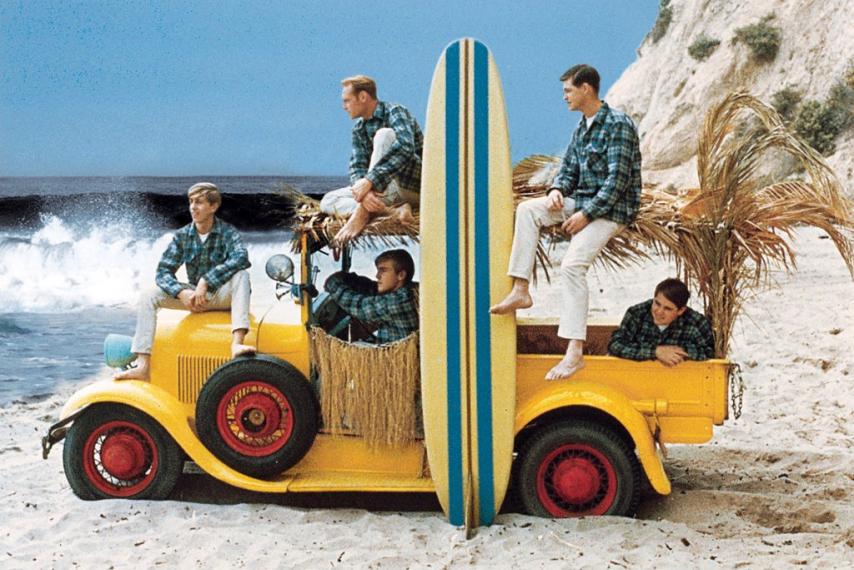
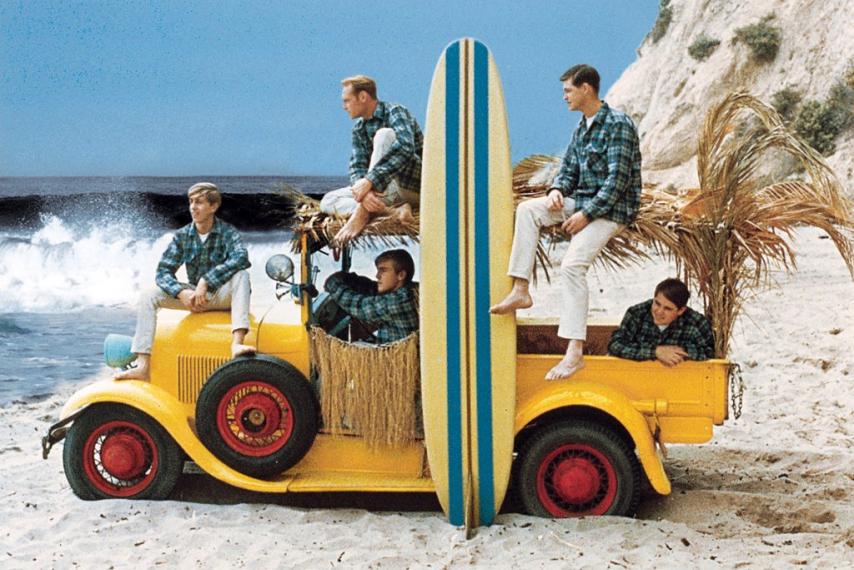
I DON’T EVEN SURF. BUT THE BEACH BOYS MAKE ME FEEL LIKE I CAN. Heck, I don’t even think The Beach Boys surfed. They rarely even dressed for the beach. Except Dennis, the tousled stud. Those preppy bumclench trousers would have lasered off their gonads if they’ve tried to do watersports in them. Maybe that’s how they got the high notes. So for a band that’s predominantly famous for songs about surfing, not being all that surfy but making other people feel surfy is quite a feat. No one else could pull such blaggardry off. It would be like Mumford & Sons banging on about cricket in three out of five songs or Adele writing an album called 3-1 about football results. The Mumfords don’t bat. Adele doesn’t do keepy-uppies. It would be ludicrous if her biggest hit was a belting ballad about Milwall. But The Beach Boys owned surf. They owned that spirit. And they instilled that spirit in millions of others across the world, some of whom have never seen an ocean or sat on sand. That is an epic achievement. *High fives The Beach Boys*

The Beach Boys also make you yearn for things you wouldn’t normally yearn for, like hickeys under the boardwalk, malt shakes (hooey), and public proposals when you are not of legal age. All that nonsense that sweeps around inside you like West Coast waves of imagination when you listen to them. Wouldn’t It Be Nice makes me want someone to get down on one knee and propose to me with a Hawaiian flower garland or a Cadillac tyre. I’d wear it, I actually would. Don’t Worry Baby makes me want to worry, like really demonstrably worry about everything, just so I can have someone sing that song to me. And I’m still really hacked off I’ve never had a friend called Rhonda. Even though Rhondas seem to take bloody ages to come to your aid when you need them.

And as with all songs you love with a fierceness, you get protective over them. When Richard Curtis used God Only Knows in Love Actually I almost kicked off. I hated him for it. “Don’t use that song, Richard – it’s not yours you schmaltzy twit. It’s mine. It’s everyone’s. But it’s not yours”, I bellowed in my head the first time I watched that atrocity, and again when I watched it, guiltily, for the thirtieth. And of course – that’s why Richard Curtis used it. Because God Only Knows with its ascending harmonies and its guileful magical repetitions evokes powerful emotions; emotions so powerful by a song so powerful the rest of the film somehow gets protected by some sort of by-product forcefield from its own shitness.

Despite all this, seeing Brian Wilson could so easily have been something I missed. I saw the tickets come on sale at my local theatre. I emitted a little ‘ooh’ at the delicious unlikeliness of Bri sticking even one Californian toe in Essex, then I cracked on and forgot to buy any. They sold out, fast. Luckily a friend had a spare and with that casual exchange I had a night I will never forget. Brian Wilson was coming to the Cliffs Pavilion. That means, essentially, The Beach Boys were coming to Southend. The West Coast, the Westest, further than Cornwall and then a few more thousand miles across another continent, was coming to our little oft-derided seaside town that I happen to love. That’s BIG.

I instantly wanted to go to the theatre and paint the dressing rooms. I’ve been in there. It’s alright for others, they can Flashwipe their own lavseat, I haven’t got time to look after everyone, but now Brian blinking Wilson was going to be shuffling around, humming like a total cutie, sitting on the same seats as mortals. I wanted to sneak in and steamclean everything, knock down some partition walls to give him more space. Make our beach better. He was going to judge our beach.  A BEACH BOY WAS GOING TO TAKE ONE LOOK AT OUR PEBBLES AND WONDER WHY ON EARTH WE DIDN’T GO TO THE EFFORT OF ENSURING THE REQUISITE PHASES OF GEOLOGICAL CRUMBLING TO MAKE IT NICE FOR HIM. Then I realised that Brian Wilson wouldn’t care about all that tosh. Because Brian Wilson is hard.

But Brian Wilson is not hard.

Seeing him sitting at the keys on the stage made me do a little heart vomit. He looked so…old and frail. He stopped the opening of one song because he had heartburn. A dude trotted on stage to give him some liquid medicine which I hoped was hard liquor or the elixir of life to give him a little pep, but I suspect it was just swanky Pepto Bismol. But he did it. I heard the whole of Pet Sounds, live, plus extras. And it was amazing. And I cried. It was The Beach Boys. Well, Brian & Al Jardine. The others are…busy. (Not dead. Busy. The Beach Boys do not die.)

I turned round in the middle of Wouldn’t It Be Nice to watch the thunderous crowd behind me, up on their feet, arms in the air, singing. There in the air was everyone’s lives pooled in an invisible collective – all our memories stored in these songs, our youths, the youths we never had but imagined, the better young people that live somewhere inside us, the surf and the sea and the young love and the promise of growing old with that person The Beach Boys tell you you will find, were all there as we grew 90 minutes older and younger together.

I had an awful thought in the middle of the almost eerie You Still believe In Me, that this might be the last gig Brian played. A horrible guilty longer-than-nice thought about him just lying down afterwards and never getting up again. In bloody Southend. Later, in the bar, friends said they’d thought the same. I either hang around with some of the most maudlin people ever, or there really was a quiver of something frail in that tender-boisterous wall of joyful air that night, and we all felt it.

I walked home holding a mug with his face on. Not because I don’t think mass-produced merch is the complete antithesis of the artist’s soul, but because that mug was the closest I’d ever get to hugging Brian Wilson.

Few people get to play. Fewer get to play to millions across the world be it through machines or live. Fewer are remembered for very long. Fewer still get a chance to play themselves out. Brian Wilson will play himself out, and leave us the songs, on loop, ascending in endless harmonious thirds around the world, forever. The Beach Boys are in us.

1338301060854-cached

My Portobello Affair

I have a confession. I am totally cheating on the Thames Estuary with the North Sea. Right now. Today. It’s my day off and I needed to get out of the city to realign my noggin so me and the gals hopped on a bus down to Portobello and after 20 minutes of jiggling here we are. The beach. As I walked down the hill, eyeing up the big bad blue-grey of the indomitable seething waves, I couldn’t even pretend I was going to behave myself. There it was. The irresistible sea. I can’t figure out if temporarily switching affection from home to exotic waters is that bad. In one way it feels like having an affair with your beau’s fit uncle. The one that works out. Naughty. But in another, less mental scenario it feels like you’re loyally exploring your lover. The waters of the world all link up, don’t they. So really it’s like I’m just visiting another side of my partner. A day trip to another part, paying my respects to a lesser seen facet. Really, my Portobello affair is like a couple’s retreat. One where you fall into natural appreciative contemplation of each other, your life together. Not one of those expensive ones where you get to air your differences with a counsellorwho encourages you to bash each other with polystyrene bats though.


Is it strange to feel loyal to a thing that’s not a person? I feel loyal to our little strip of Estuary. It’s like a person to me. A tumultuous lover, a steadfast friend, a welcoming aunt, a projection of my father, a swirl of everyone and everything. A dipping pool of everything you need. I’ve lost count of the number of times the 7.4 or whatever mile stretch of seafront has sorted my head out. It’s always there. It stays in your blood when you’ve grown up by the sea. You can almost feel your body angling itself towards it. The sea is the North in my compass. I’m always pointing that way. You feel a bit hemmed in when you go inland. Where’s the water? It’s not right somehow. And coming home, the first sighting of the water is when you really know you’re home. That’s when your insides settle and your traveler’s equilibrium is righted.


I can’t believe this is the first time in ten years of doing the Edinburgh festival that I have thought to come down here and have a spot of sea goodness to clear my head. You fall into a groove that becomes a rut easily up here. Pacing the same streets to get to the same places, your schedule rotating around four or five points. Theatre and bars and restaurants and Tesco and your temporary home.


But not this year. I needed to get out. So Portobello it is. Smooth yellow sand, very unScottish sunshine. The sea looks so full it could spill out; drip down and out of the sky, wash towards you with the excitement of a waggy-tailed wetly-greeting dog.


I’m going to go for a paddle. I’m going to take off my shoes, roll up my jeans, and go and stand and wince in the water. Feel the lower degrees of the ocean coldness, the kinder tendrils of the killing cold of the deep, still brusquer than the chill of the Thames. Feel the roughness of it. The shifting sands, gurgling and gushing away, never the same thing twice. The frantic assault of the toes. Be righted by it for now, a tonic, a day’s affair, a rough kiss. Finish the festival. Then come back to the familiarity of home. 


Feck. Arse. A Girl’s Lament.

I had forgotten the promise I made about celery. It was only as I pulled my punky fishnets on for the first time and caught a glimpse of myself performing that graceless shimmy requisite for getting tights on that I remembered my play required me to get my arse out. Every day. For a month. It’s a girl punk play, with a scene that briefly requires a moment of indelicate bearing. And now here I was about to do it for the first performance of the run, and my arse was… there. Bare derrière de bleurgh. Like a nemesis I’d forgotten I had because it’s always behind me, like the past, or that man who spits in a cup outside Iceland. He gets everywhere. Everywhere you turn. He gives me the heebies.

I immediately blamed the writer for this heinous scene. Which, as she was standing in front of me in the mirror getting into costume, was quite easy. Who was this idiot? This girl in the looking glass giving me a shifty look? She knew she’d messed up, I could tell. I shot her an evil then looked away. (She copied my move to the letter so I think we know which of us has the real imagination.)

The tights, by this point in my inner dialogue, were mostly up. The legs part isn’t difficult, you kind of just stick them on your feet and pull like you’re trying to start a lawn-mower from the 80s, but the real coordination comes a little higher, around the gusset, tummy and waist. You can’t just pull and leave it where it lands. You must seek the precise coordinates for comfort, the latitudinal-longitudinal bullseye for the fabric to stick to, each patch in the elastic weave has its right place against the right bit of skin. You know when it’s right; you can just feel it. The Dance of the Tights is an epic search for Perfection, a metaphor for the Struggle of Life squeezed in to anywhere from thirty seconds to three minutes depending on how much time you have for this most symbolic of acts. Part peekaboo dress-tease, part wrestling-style hoiking appended with the very real danger that one wrong jerk could temporarily deaden the bit that makes you go ooh.

So. My arse.

I’d promised myself a fad diet of celery and spinach to deal with the partial nudity. Boiled water with hint of lemon. No cider when the summertime hit, a big no to bread. Fresh air with mashed cloud and a drizzle de rien. But then I had forgotten these rules instantly and carried on living my life. Panic-cramming cashews into my mouth while slumped with exhaustion at my desk, licking unidentified smears off the fridge door in case it once had Vitamin D in it at any point during its shelf-life, and carrying a banana on my palm to work to test the potassium-osmosis theory. (Don’t google this – I just made it up. I feel immense pressure to like bananas. But I never really do.)

And now I was doing that crick-necked craning thing people do over their shoulder, trying to look at parts we have no anatomical business looking at. The bum, the arse, the bottom, the heiny, the tukkus, the butt, the “You will never be Beyonce, bitch”. That thing we’d have no personal aesthetic awareness of if we lived in the wild. Who invented the mirror? Who developed that trickery of glass so that we could see ourselves? Before we would just walk around beautifully unaware of what we looked like. We might glimpse ourselves in nature’s mirrors – ponds and lakes, shiny stones or waxy leaves – but nature is kind enough to obscure us with ripples or dappled light, we never see the full reality. And I bet, pre mirrors, few people in history ever stood by a lake, lifting their skirts, trying to look at their own butt.

In the end I just went out and did it. I did the play and I got my arse out and then I put it away again. And despite my dressing room fear and loathing I didn’t think much of it. It was too brief to dither about it and I had to move the story on through to the end, an arseless denouement, so I could hotfoot it offstage and have a beer. With some celery in it like a Belgian Bloody Mary, a tip of the hat to forgotten promises.


N.B. This is not my arse.

fishnets