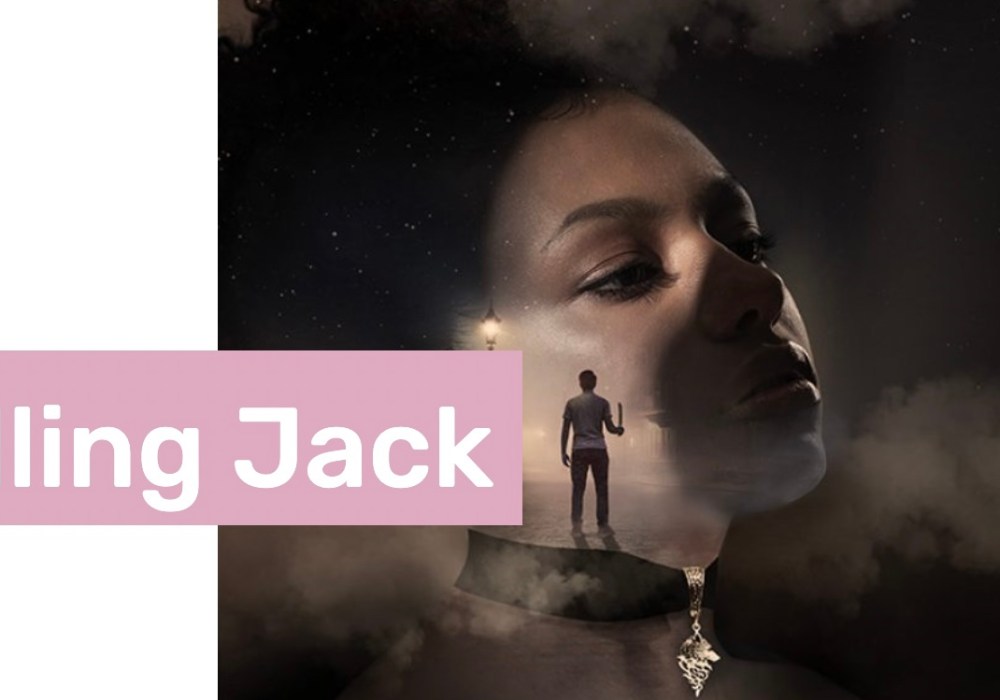
Killing Jack – or – how do you write a play about Jack the Ripper without making it about Jack the Ripper?

Like many people (surprisingly, mostly women) one of my guilty pleasures is cosying up at home and watching a nice programme about serial killers. Fred & Rose? Yes please. Ian & Myra? Cor, yeah. Jeffrey, Ted, Peter, Harold, Ed. And of course all those with super cool names like Night Stalker, Monster of the Andes, and The Brooklyn Vampire. All the big boys of evil; a great evening of uncomfortable viewing. And of course – Jack the Ripper. The King. The Elvis of Murderers. (For years in my head a debonair gent with a top hat and nasty temper, incited to murder easy-access lowly whores to sate his violent mummy issues. Or thereabouts.)

While reading a clickbait article I’ve since forgotten, I realised I didn’t know how many women Jack the Ripper killed. I didn’t know their names, who they were, or if they were – drumroll – even prostitutes at all. I just knew that this wily brutal man had fascinated the world with his incomparable talent for evading escape, albeit in the pre-forensic landscape of Victorian London. Was he an angry pauper, a butcher, a lunatic, a charlatan yank, the queen’s doctor, or even her grandson and thus heir to the throne? Jack still had the knack, almost 150 years later, to keep an worldwide army of macabre enthusiasts on their toes.

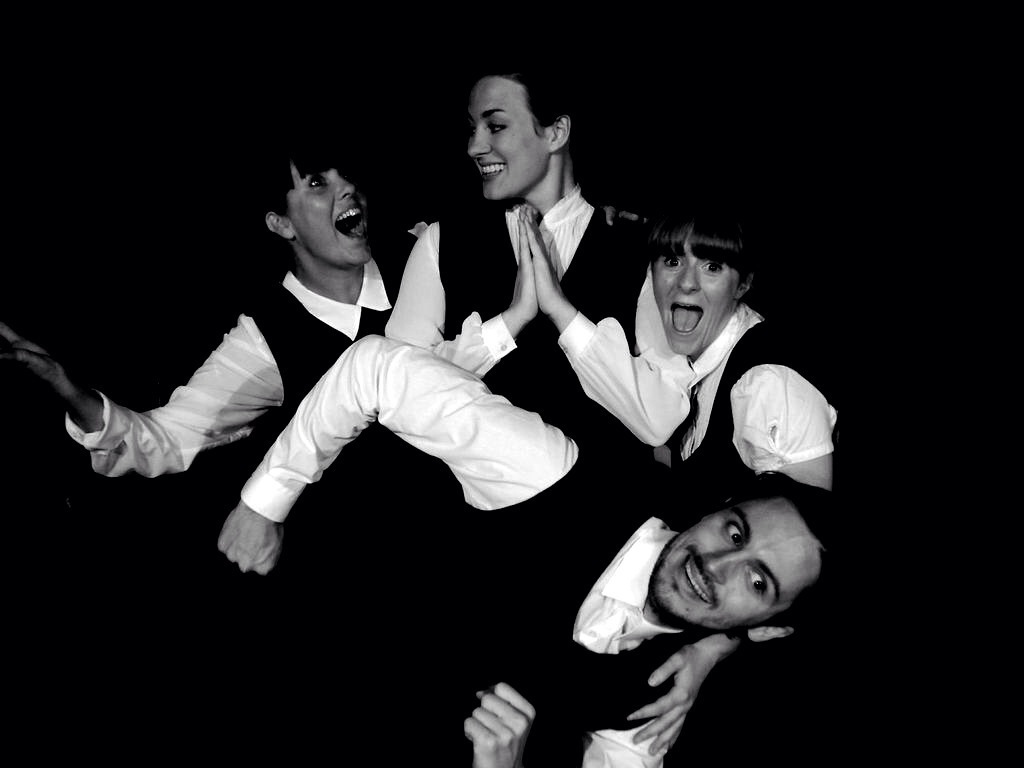
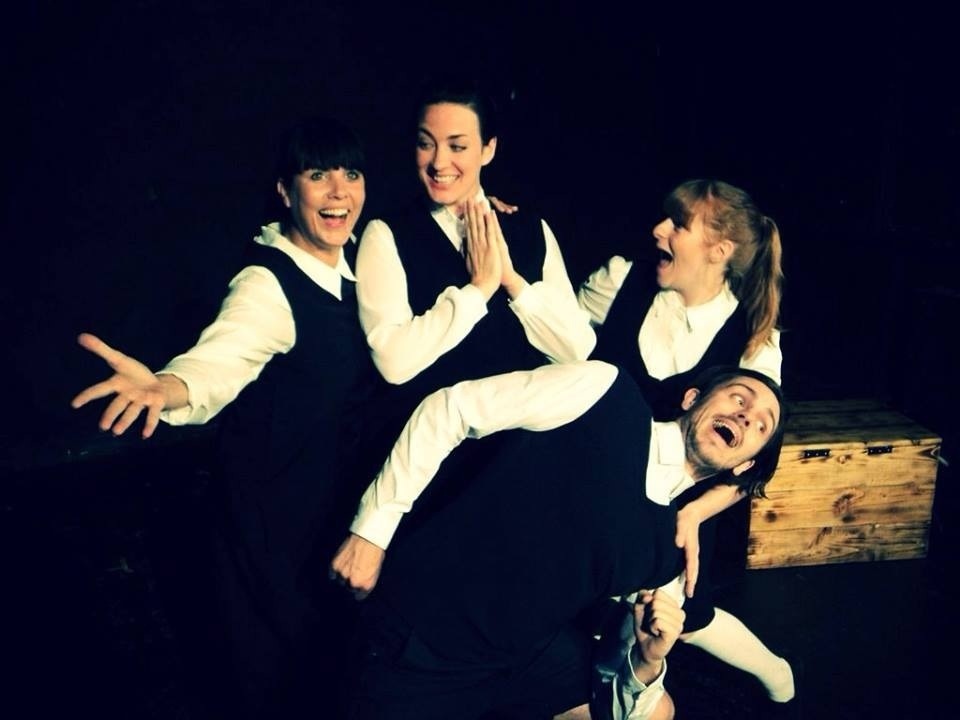
No one play could ever give justice to the women who lived such heartbreakingly difficult lives and died such barbaric deaths. So, after almost a year of many drafts and beating myself up, I stopped trying. What good could I ever do these poor women? Which aspects of their five very different, wildly unique and fascinating lives should I even try to begin to boil down for a ninety minute portion of ‘entertainment’? Did I have the right to try?

Since I couldn’t write a five hour play, I decided the best I could do for them, aside from shining a light on them, showing them some love, and completely removing Jack the Ripper as the central character (a furious instinct from the start), was to try and do the best for women in general. Explore what has changed since Polly, Annie, Liz, Kate and Mary Jane’s murders in 1888 changed the world. With their deaths they gave us a villain to love – Jack – and we gave them nothing.

As I researched, I quickly grew weary of all the usual Ripper bilge. As I began ignoring the countless resources written largely by men, I even questioned whether I had picked a dud subject for a play. These male (self-proclaimed) experts were mostly old idiots who didn’t give a fig for the women. Amateur Sherlocks who got a hard on coming up with their bulletproof theories on the Ripper’s identity. I found myself sighing and rolling my eyes on a very regular basis. But it wasn’t boredom or ambivalence I was feeling, it was a frustration that would very quickly turn to full-bodied rage.

Then, inevitably, thank god, I found The Five by (ALL HAIL) historian Hallie Rubenhold and promptly stopped reading anything else written by a man about the bloody Ripper. Even the arch irony of Bruce Robinson (writer of the iconic Withnail & I) in his lengthy tome They All Love Jack was too harsh after the mammoth act of empathy I had just experienced in reading Hallie’s The Five. Because I knew now that I did not actually care about the Ripper at all; I cared about the women. I didn’t give a tiny rat’s turd about who Jack was. I wanted to know who Polly, Annie, Liz, Kate, and Mary Jane were. I couldn’t – and wouldn’t – read any more about them being prostitutes or fallen women or drunks or unfortunates or bad mothers or unrecognisable corpses. Even the ironic use of the word ‘whore’ coming from a cerebral man like Bruce , even if he was ejecting it in allyship to them, was just too much. Five pages and I was done with him too.

But how do you write a play about Jack the Ripper without making it about Jack the Ripper?

Around the same time I was also dipping my toe into the (dangerously addictive by the way) world of genealogy; going giddy over the new connections that exploded keenly in the staggering diagram of my family tree; just a few little clicks and there they were; the people that came before me. It was all there, I had just never looked. With a history of alcoholism and domestic abuse on one side, and military brand coldness, poor mental health and suicide on the other, I suppose it was always something of a daunting task to exhume the people who forwarded their DNA onto me.

I had always thought my dad’s side were largely Welsh and before that Austrian. But between those nationalities I discovered a whole stratum of London and Essex ancestors which wove coincidentally close around the Essex and London timeline of my mum’s relatives. I found my paternal great great great grandmother, Julia Hasler, and something about her kept me prodding around for more records more than any other mystery bud on the tree, quietly asking for me to invest my time and let them speak.

Julia had ten children, all of them illegitimate, and not many destined to survive beyond childhood. Julia survived for the most part by casual charring, one of the lowest forms of employment back, even for women. She spent her adult life in and out of workhouses, particularly during late pregnancy and early maternity, presumably seeking the only form of (cruelly basic) care that would be bestowed upon a woman of no means. Some of the babies never left the workhouse infirmary. In later life she found more secure employment in service at a house, a longterm companionship with William Yelland, her widowed employer, and later marriage. It seems William embraced the remaining children from Julia’s unmarried life as his own, and these children took his name out of respect (and probably to spare their mother’s unmarried blushes and give her a sense of dignity that had previously evaded her).

Something about Julia fascinated me. Her lostness amongst her (albeit struggling but nevertheless relatively stable) family. Perhaps I was drawn to her sheer daily battle to survive; some sense of retroactive grand-daughterly sisterhood spiking in me, hoping to be of some sort of ineffable post-humous comfort to her and what she went through to make it possible that I was ever born.

I wrote to a living link on the tree – a cousin in Canada, much older than me – and asked what he knew of Julia. He said he didn’t know much but after years of searching for her records, and talking to other genealogy experts, it was suspected it was highly likely that Julia spent phases of her life supplementing her charring work with casual prostitution, hence the illegitimate children, periods in workhouses, and black spots in her records. It was just so common for women to be forced to consider selling sex as a means of survival back then. I went back through her records with this in mind. As far as we can ever fill in the gaps, it made sense.

As my research into Jack the Ripper was underway at the same time I was deeply immersed in Victorian London, and couldn’t help but be struck by the similarities between Julia’s life and the women I was reading about. She was living in the same parts of the East End at the same time, and likely doing the same things to survive. Then it whacked me like a spade in the face. It could have been her. So easily she could have been one of the women who fell within the late night prowling ground of the man we call Jack. She could have by slim coincidence been one who got away; who slipped just shy of the same fate. Hundreds of women without a bed who walked and slept on the streets could have been. But knowing that one of your family was alive in 1888 in the very stomping ground of such evil, there to hear the news firsthand, to feel the terror in the streets, perhaps to pause her own industrious night-times until it was safe again, cast my empathy in a kind of warrior iron. I was not just ready to feel for these women, I was ready to fight.

Because what has changed since 1888? We are still told, if we walk home alone late at night (or any time, depending on where you live), that we are bloody stupid – for it is still so chillingly likely that something could happen to us while we dare to take that chance. Some women, like those in 1888, don’t have the means to secure their own safety. Some women have to work at night, some women can’t afford cabs. Some women aren’t housed. Some women haven’t got the option to choose safety.

Every night that we make it home safe, we are all the one who got away.

Every single woman on this planet – present and future – is a few sad circumstances, some bad luck, one night on the wrong street away from being Polly, Annie, Liz, Kate, or Mary Jane.

A play in their honour is a drop in the ocean of what they deserve. But these remarkable women will never leave me now – they are real heroines with permanent residence in my heart. I hope they’ll find that in others too.
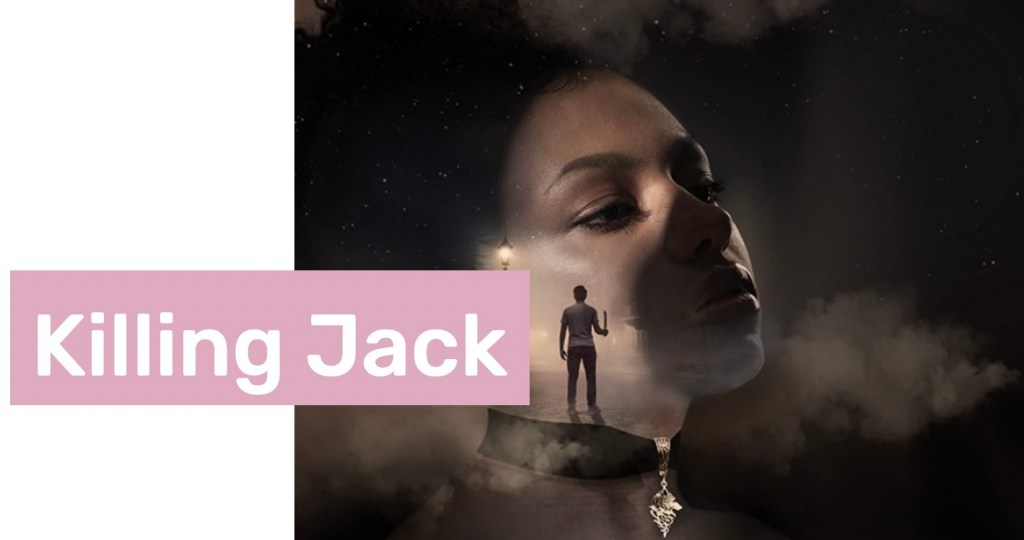
Running at Queen’s Theatre Hornchurch, 26 Oct – 11 Nov 2023

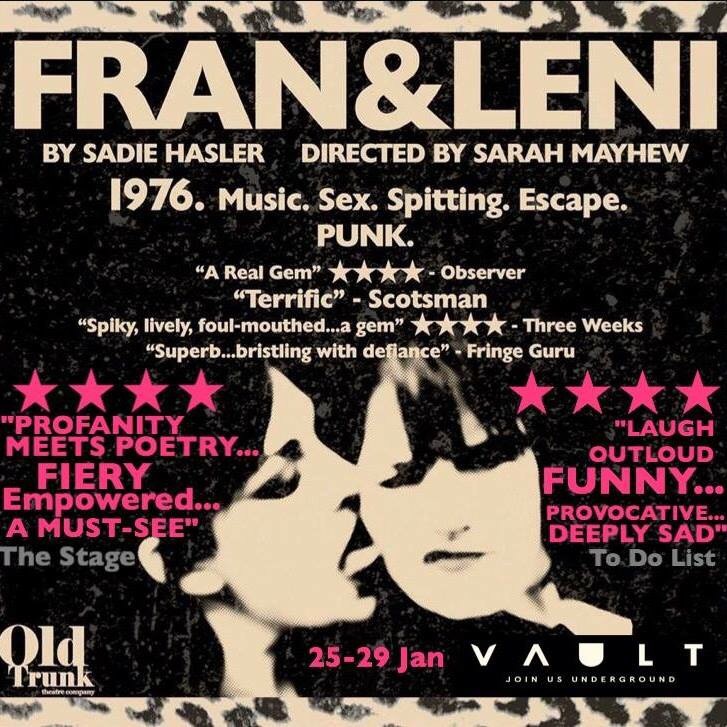
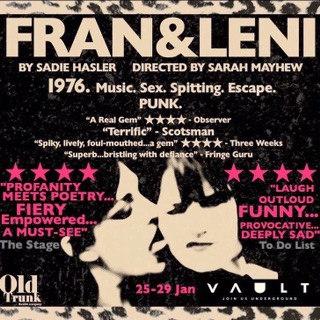
FRAN & LENI – VAULT FESTIVAL LONDON – 25-29 JAN

THE PLAY THAT PUNCHED THE TITS OF LATITUDE & EDINBURGH FESTIVALS COMES TO LONDON… 

1976. Fran & Leni meet in a North London comp. 

3 years later they are The Rips. Girls with guitars, bored of playing nice. 

“Profanity meets poetry” ★★★★ – The Stage
“Laugh out loud funny…provocative…deeply sad” ★★★★ – To Do List 
************************ 
Two very different girls escape from everything sugar & spice in this full-throttle tale of lifelong friendship. 

By Sadie Hasler. “Twisted genius” – GQ 
Directed by Sarah Mayhew. “Inspired” – Fringe Review 

Featuring the voices of Phill Jupitus, Lizzie Roper, Alan Cox, Ricky Champ, & Marc Mollica. 

Original music written by Tuppenny Bunters, with lyrics by Sadie Hasler. 

Vault Festival London – 25-29 January – 19:45 – BOOK
TRAILER – https://www.youtube.com/watch?v=jj2Qda7Fomw

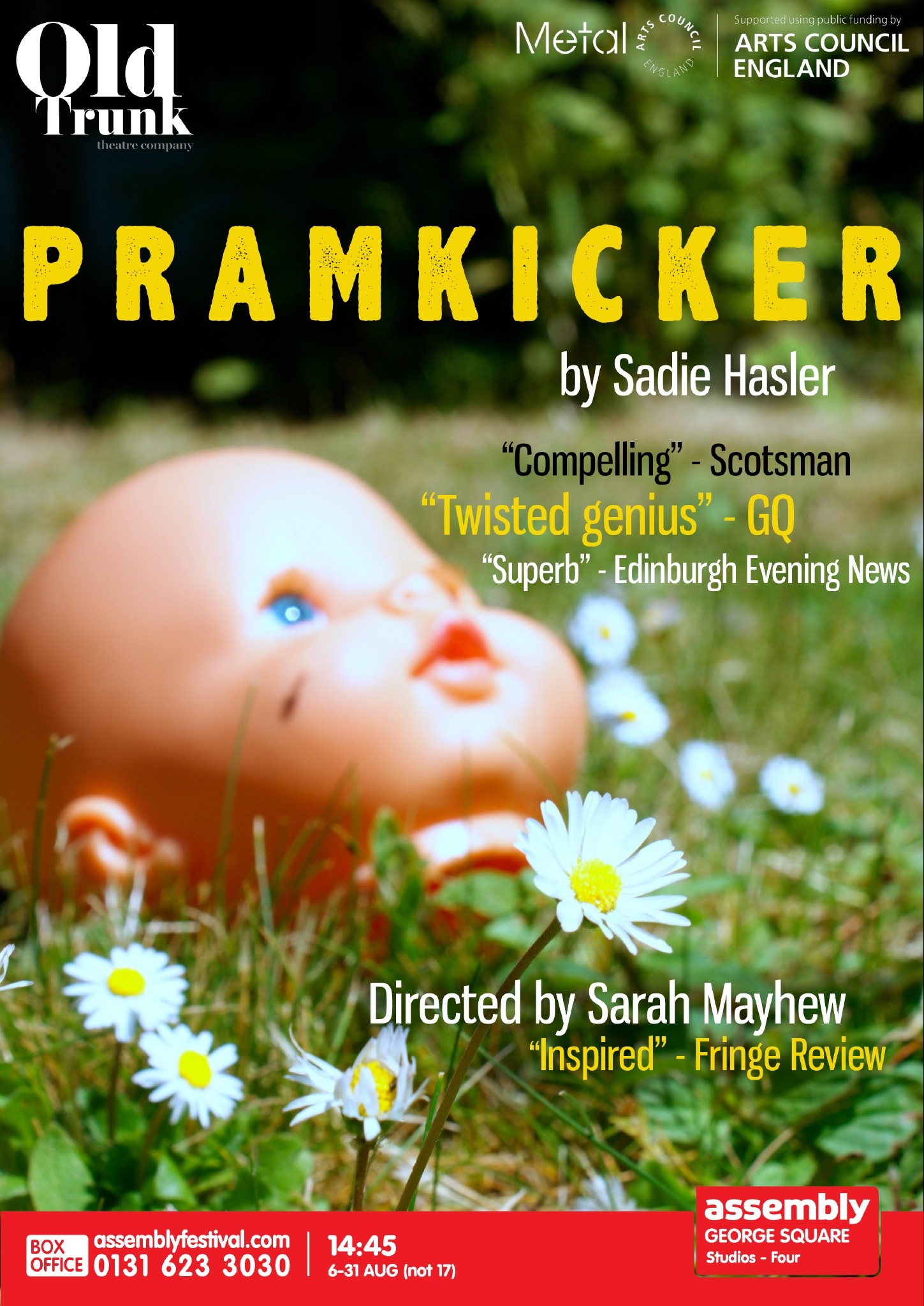
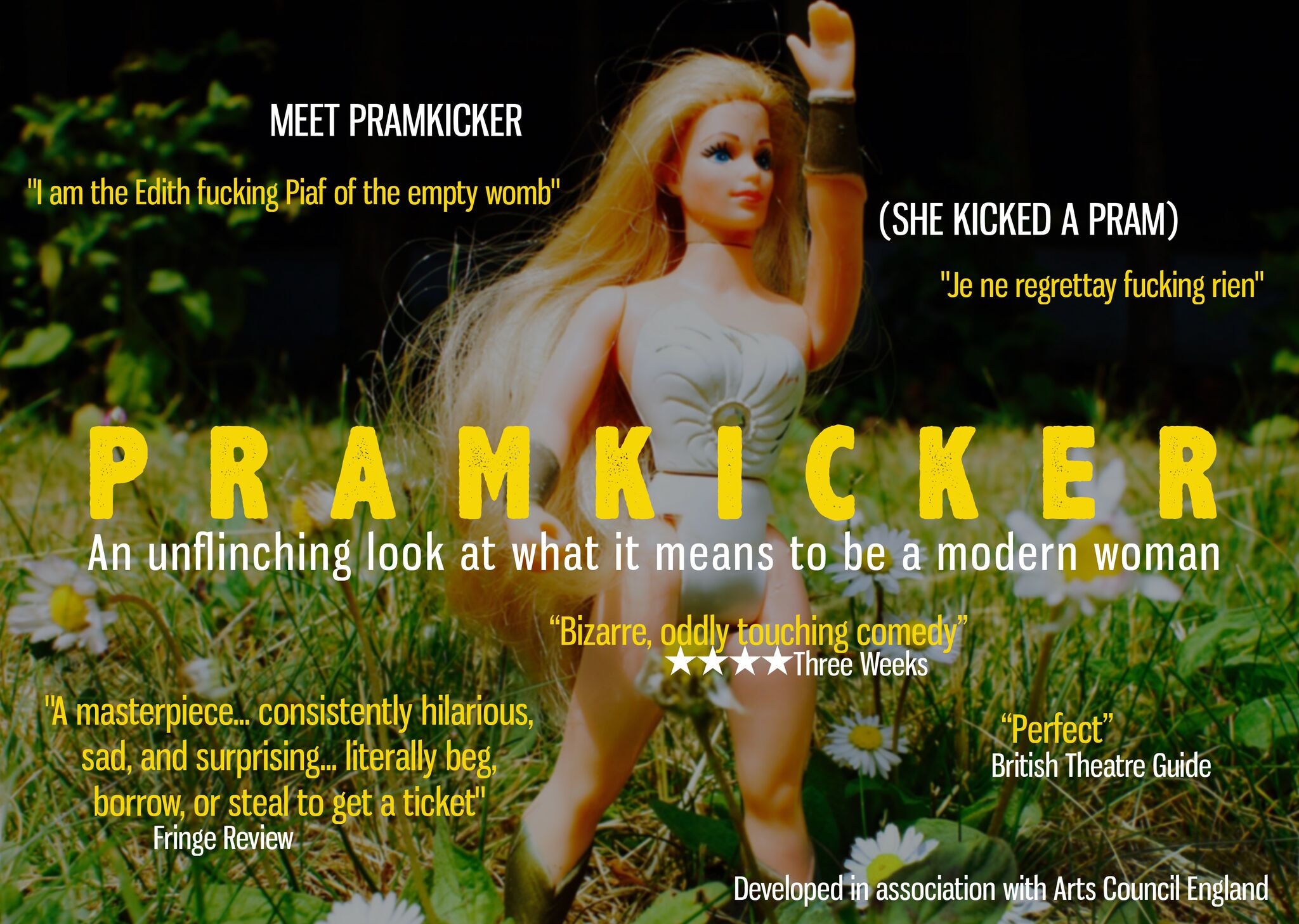
Pramkicker: It Started In A Café…

Back in the distant yorey days of 2014 my friend Sarah and I were in a café. I was ploughing on with a triple shot Americano even though I’m a bit allergic, & Sarah was staring at me wondering why I didn’t just order tea. While we smalltalked a stream of mothers filled the cafe with their exuberant offspring and their high-tech perambulators. We smiled & nodded hullo. I crossed my eyes and did fish-face at a toddler who stood staring at me with a swollen nappy bum. As the hubbub in the cafe grew louder Sarah and I spoke a little louder to try & continue our Very Important Power Business Meeting (or VIPBM if you like anagrams that sound like virus software), which no doubt involved our dreams and aspirations for the next ten years, our relentless charity work for worthwhile causes, or what to have for lunch that very day.

Then Sarah got elbowed in the head by a mother who didn’t even turn round let alone apologise. Then I picked up a toy that was hurled at my feet – a little fleecy lamb, tired at the eyes from too much washing – to be met with a glare as though I was the leader of an international paedophile ring out and about scouting for talent. My cheeks flushed. Because I am not the leader of an international paedophile ring, people. I can just about manage my own menstrual cycle (it tends to work best when left to its own devices; you can’t lasso the moon) let alone operate on a highly criminal, covert, and morally reprehensible basis. We eventually felt so uncomfortable, so invisible and surplus to requirements that we left to find another cafe somewhere else, maybe in a neighbourhood known for more knife crime and fewer mother and baby groups, even though we knew more coffee would probably make my cheeks go pink and my throat go all constricty like I was being strangled in a cartoon where the tongue bursts out of the mouth like a party blower. JUST ORDER TEA, HASLER, YOU NITWIT.

In the street we began a conversation about motherhood and kids, dodging prams as we went. Sarah has often said she feels belittled by people who think she’s selfish for choosing to remain child free. She maintains that it’s selfish to have children if you aren’t sure you want them. I reissued my regular mantra that I haven’t a ruddy clue about anything; whether I want kids or not; that I sometimes have a pang, but not much. Not enough of one. Yet. I have received no bugle call and thus am at leisure to continue my wafty existence.

But. But I am 35, and aware that inside my tiniest parts – deep inside the intricate folds of my reproductive system, a work of genius I can take no credit for – is a clock, at some point at my prime wound tight and ready to burst its cogs, that will – at a time never to be properly administrated by myself, the me up here in my cerebral offices – start slowing down, slowing down, slowing down, until eventually it stops. Tick tock, tiiiiick toooock, til the rest is silence. My baby-making days over.

It’s not often that an ordinary morning spurs you to go home and write about it, but that day, in that cafe, a chord was struck that echoed. Very shortly afterwards I began writing my new play, Pramkicker, which became something of a melting pot for all the thoughts I had about All That Stuff, and a lot of thoughts I’d heard voiced by other women I know. It felt like a mess of conflicting concerns in my head that I needed to untangle – time and love and the human body and prospects and career and fulfilment and cherishing life and the possibilities and difficulties of all that – and writing is the only way I know how to go about trying to untangle anything. Writing is the way I process life, it’s how I understand, and more often now how I participate. Writing is what I do while and after I think and before I act. If I act.

I don’t normally talk about things I’m writing because I’m not very eloquent at saying what it is. I get all flustered and say ridiculous things like “It’s about a kind of story but I don’t know what yet.” And then people just stare at me as though they think I should probably take up watching telly instead. Most of the time I completely agree with them.

But what has been lovely with Pramkicker is that I’ve been talking about it lots. With lots of people. Men and women. Because I’ve wanted to know what other people think and feel about it all. And lots of people have been starting conversations with me about it too, and as always I have been reminded how lovely it is to share things with people. I’ve received so many messages from people who have things to say about motherhood; confessions or open comment about having kids, or not having them. About quandaries, about regrets. About sad things the human body throws at us, about the ticking of the biological clock. About knowing and not knowing. About how different humans go about filling their lives with different kinds of love in that strange vainglorious beautiful doomed pursuit of finding permanent happiness in an impermanent life, that cruel instinct that humans have that bumps alongside the behemoth business of merest survival. And while thinking, talking, or even writing about ‘all this baby stuff’ hasn’t made me any clearer on the matter, it makes me realise that whatever happens, with kids or without, I won’t be alone. None of us ever are if we choose to talk to each other.
Let’s just not try to do it all together in the same café, eh.

image
image

Doing It

About twenty one months ago or thereabouts, I blurted out something in bed that’s gone on to change my life. I was talking to my best friend (texting, on the phone – she hadn’t just swung by and hopped in to keep her feet warm) – and having a moan about some idiot we worked for. A shambolic cretin who never paid anyone, who – we had just discovered – wasn’t even using his own name such was his checkered past of shady incompetence. We were hacked off. We knew something had to give. So I blurted. “I just want to do plays all the time, like, run a theatre company.” There was a pause just long enough for Hew to type “LET’S F***ING DO IT THEN, WENCH.”

So we did. Or started to. Our complicity in those moments turned our energy from low and despondent to wired and exuberant. It was quite an unceremonious beginning really, I suppose. I was in bed for one thing. But it felt important.

Few things we say in a day actually bring about change in our lives. There are small things, like “But I don’t fancy steamed fish tonight, I fancy steak, a bloody big one.”, but rarely something monumental to altering the progression of your time, thoughts, actions, and priorities for a considerable proportion of your future. Something that in its simplicity and brevity at once casts out all other options.

“I just want to run a theatre company.”
“So let’s do it then.”

Our company Old Trunk will turn two in June. I will turn 34. It seems a good age to have realised suddenly, after a life of drifting from thing to thing, that you know what you want.

We have had, I’m sure, an untypically blessed start for a new company. Since our eureka moment we have produced two plays I wrote which have been very well received locally and in London, been funded by Arts Council England twice in an increasingly difficult financial climate with cuts being made left right and centre, represented the Arts at the House of Commons, and appeared in the Sunday Times magazine. Lots of other lovely stuff we’re proud of.

I know that our success so far is largely down to our defiant determination to work our socks off constantly to the exclusion of most other things, to the amazing talent we are lucky to have in our cast Charlie and Edd, but we also owe the angle of our trajectory to some other wonderful people.

We’ve been lucky enough not only to have wonderful patrons, but also to be mentored by an arts organisation called Metal. They heard of our work, and asked us to curate the theatre tent for last year’s Village Green festival. We were honoured. They mentored us through the Arts Council application, offered invaluable help, introduced us to a whole industry load of thinking that we, being new, simply didn’t know and stood no chance of rapidly discovering for ourselves. They came to see our shows, and spoke up about us to other arts groups who didn’t know who we were. We were nothing but a couple of plays and a big bag of vague wishes that might never have been realised, but then we were given the clarity and support to do something with it. Because of their mentorship we are now being funded to take our two plays to the Edinburgh Festival and we’re so happy and excited we can barely make it to the end of an hour without sighing like girls.

We don’t know what the future will hold. We’ll work hard to keep ascending, doing the things we love, and are actually now bolstered even further by the desire to not let our supporters down.

It took a moment of ‘sod this’, of saying “Let’s bloody well do it”, but it also took people believing in us and opening a door as wide as our own scope to dream.

20140311-132310.jpg

Review – The Secret Wives of Andy Williams

A review for Old Trunk’s latest play The Secret Wives of Andy Williams, which premiered at Camden People’s Theatre in August 2013.

Low Down

It is rare in film, theatre or any art form to encounter a follow up show, a prequel or sequel that is as good if not better than the first. This unique occurrence has happened with Old Trunk and their new show The Secret Wives of Andy Williams, the prequel show to their stellar hit production last year, Watership Breakdown; The Bastard Children of Remington Steel. For background both shows are set in a nunnery where orphans and strays are taken in and looked after.

Review

Secret Wives of Andy Williams is every bit as quirky, honest, funny and engaging as the last production and yet manages to retain the same voice despite being about the nuns taking the front row seat over the orphans. Only one character remains as the through line, Sister Mabel Matthew, and yet the style is the same and so it feels undeniably like a prequel. The characters are exceptionally well formed and it is clear a huge amount of work and passion has been applied to enable the audience to fall headfirst and fully immerse in the stories of these likeable, unique characters.

The team of performers are very tight knit with only one actor different from the production last year. The addition of Edward Mitchell as Susan and Sister Gertrude has added a wonderful new dimension to what was already a fantastic group dynamic. Mitchell adds a sparkle and twinkle to this strong female trio and the balance that is created ensures a great sense of harmony. Mitchell is an excellent character actor, seamlessly switching from one to the next with not even a beat. Men, women, old and young are all delivered with the same level of passion and commitment.

Sadie Hasler is truly destined to lead the charge as we discover the next generation of prolific writers in the UK. I wouldn’t be surprised if she is not the name on everybody’s lips both for theatre and TV in the next year or so and I can certainly say I was lucky enough to witness the humble beginnings of that greatness at the Camden Fringe. Her trusty co producer and exceptionally talented actor and comedian Sarah Mayhew yet again reveals her attention to detail with character; playing Sister Clara, the obnoxious yet misunderstood Enid and Queenie Bee, all completely unique and utterly convincing. Charlie Platt is delightful as the confused young nun Caitlin and her sense of fun and innocence in this playful role is totally charming.

Hasler has delivered another little piece of heavenly storytelling to the stage and no doubt there are many more to come! I for one cannot wait to see what’s next for these nuns!

20130919-102617.jpg

Tambourine Girl

The last time I shook a tambourine it was quite by accident. I was carrying it for someone in a band who let me help load a car so that I could pretend I was a rock star. As it jingled lightly I felt guilty – as though the Gods of music might smite me for daring to unsettle their percussion with my arrhythmic clumsiness.

The time before that was as the backing singer in a staff band named Detention when I was a teacher, but it didn’t count because we only played to a hall full of nonchalant kids at the end of term. ‘As a treat’. It didn’t matter if they didn’t think I was any good because a) what did they know about anything anyway, and b) I could just give them Ds to make myself feel better.

I’m one of life’s tambourine shakers. Because it’s the only way, other than humming, that I can join in with that almost celestial art, Music.

But a tambourine accidentally fell into my hand again last week, drawn to my fingertips by that powerful sorcery of wanting to make a ruddy noise. I was very privileged to be the only non-member to enter the rehearsal room of awesome band The Lucky Strikes. I thought that I might disintegrate on entry to that hallowed ground, but instead I walked through the door and was whammed in the nostrils by the smell of stale farts that had soaked into the sound-proofing over the years. It put me at ease somehow – despite the fact breathing had become markedly harder.

I was there to work with the boys on a show I’ve written called The Vagabond Diaries, which sews together stories inspired by their songs. Collaborating with proper musicians was a new thing for me. I was a little daunted by having to speak up in case the language and methods of an actor-writer sounded dumb to cool musicians. I didn’t want to sound like a wanker. But once they started playing (‘jamming’ I believe it’s called in the trade), I got so excited to hear the words I’d written coming together with their amazing songs that I forgot that I wasn’t actually a part of the band.

That’s when I may have picked up the tambourine. I may have tried to do a bit of shaking against my leg like a hippy in a scout hut. The boys looked at me. I put it down and said something very clever and droll about the cross-pollination of genres being really liberating. (I didn’t. I reminded them that I had brought them cookies and hoped that would prevent them from beating me with the sullied tambourine).

I left ‘the studio’ (jargon) feeling a bit high. It may have been the vapours of ghost farts I’d inhaled, but I think it was because we all felt like we’d stumbled onto something exciting and new.

I went home humming, and as I fell into bed I thought about the old adage that music is what all art aspires to. I think it must be true. I wasn’t thinking about the words I’d written, or the stories or characters within, or the themes of the piece, or even the brilliant lyrics that had inspired me in the first place, I was humming. Just the tune. The notes repeating in that magical order. The music is what stayed with me as I fell asleep, and it’s what was there as I woke in the morning.

The Vagabond Diaries – tales of being human accompanied by the music of The Lucky Strikes – can be seen in the Old Trunk Theatre Tent at Village Green on Saturday 13th July.

20130708-091637.jpg

Legacy Theatreland

One of the many things I love about writing is that it invokes all your cerebral bustle while indulging your lazy side. You can for example have the most productive day while propped up by five pillows in old pants, long socks, and a Dolly Parton T-shirt covered in biscuit crumbs. In fact, some of my best work has been done while looking like I’ve just had a breakdown over the last Hobnob.

One of the other things I love is hearing the words I’ve spent weeks of my life writing, transcribed voices that sprung to life from a seemingly throwaway idea on the back of a napkin, spoken aloud by people I love and admire, to a theatre full of laughing people. That is my drug, my joy, my adrenaline shot to the heart.

Last week, my play The Bastard Children of Remington Steele had a run at London’s Leicester Square Theatre. It was a week that will keep me floating into next year. As with anything where you put yourself ‘out there’, you hate yourself for feeling validated by sales and response, but you sort of have to put that out of your head. It is part of it. The gumption to do it in the first place, closely shadowed by self-loathing. They keep each other in check.

In amongst hating the self-promotion and the fear, I allowed myself a rare slither of pride. Turning up with your cast and a trunk in London’s Theatreland is ruddy exciting. It feels official. It makes the weeks of muttering to yourself seem less like madness and more like an investment.

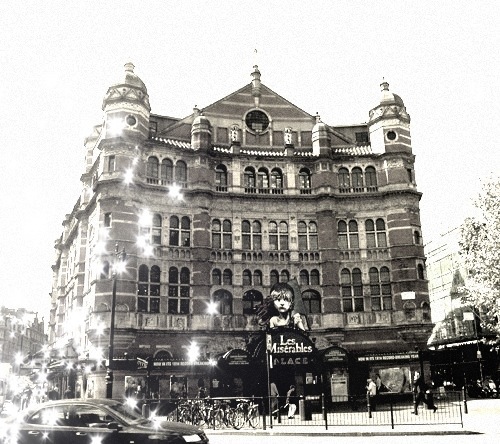
What allowed the pride to rise like a warm bun in my heart as we drove down Charing Cross on our first night was a little thing, really. I glanced out of the window and saw the red bricks of the Palace Theatre and for a few fleeting moments it was my fourteenth birthday again. I’d been spoilt, taken to the recently opened Planet Hollywood by my lovely mum, who afterwards guided me through the west-end with a mysterious air. There, on the corner outside the theatre, stood my dad. I hadn’t been expecting to see him. But there he was, holding a pint and a present. A butterfly locket. He and my mum smiled at me with the stoic partnership that separated parents must work at. They did well; I was blithely unaware of how hard it was for Mum to do that at times. Dad gestured towards the theatre and I realised we were going inside to watch Les Miserables. I almost exploded with glee.

Thinking about it now, my pride last week wasn’t an ugly indulgence. It was only rightful. It was a tribute to the hard work of my parents. It was a thank you. They worked hard to fill me with confidence and the resources to do things, make things. They gave me the sense of entitlement to the world that we should all feel. It is ours to take.

Passing the Palace, and seeing the ghost of my Dad for a moment, made me feel like I was returning to claim a tiny piece of Theatreland that he’d reserved for me.

It still seems so strange to me that a man who eventually chose to end his life could have succeeded so fruitfully in teaching me how to live mine.

I went on stage, felt the lights on my face like a hug from above. I did my play about fathers; their presence, absence, legacies. And I even remembered my lines. How could I not. They were because of, in spite of, and for him.

20130211-093430.jpg