The Tiger

My mother called me. It was very important. “Sadie. You must, I repeat MUST watch that programme about the woman who wrote The Tiger Who Came To Tea. Deborah Carr. Not Deborah Carr. She was in the The King & I. What’s her…JUDITH. JUDITH KERR. That’s it. Anyway. She’s got a thing on the dooberry and it’s wonderful. Watch it. What an amazing woman.”

After promising I would, then having a general chinwag about Christmas lists and saucepans, we signed off – me promising again to watch the thing about the lady who wrote The Tiger Who Came To Tea. I got on with my day, but I was smiling at the memory of that book. I could see the pictures in my mind’s eye as I pottered about.

The story has stuck.

It was published in 1968 and it is still one of the best selling picture books of all time. It recently got made into a stage show, which was nominated for awards. I have read it to my nephew, I have read it to my niece. It is one of their favourites. It is still piled high in bookshops with an attendant range of merchandise. Children who could not tell you anything about 1968 could tell you the story of Sophie and the tiger.

There is something in the story.

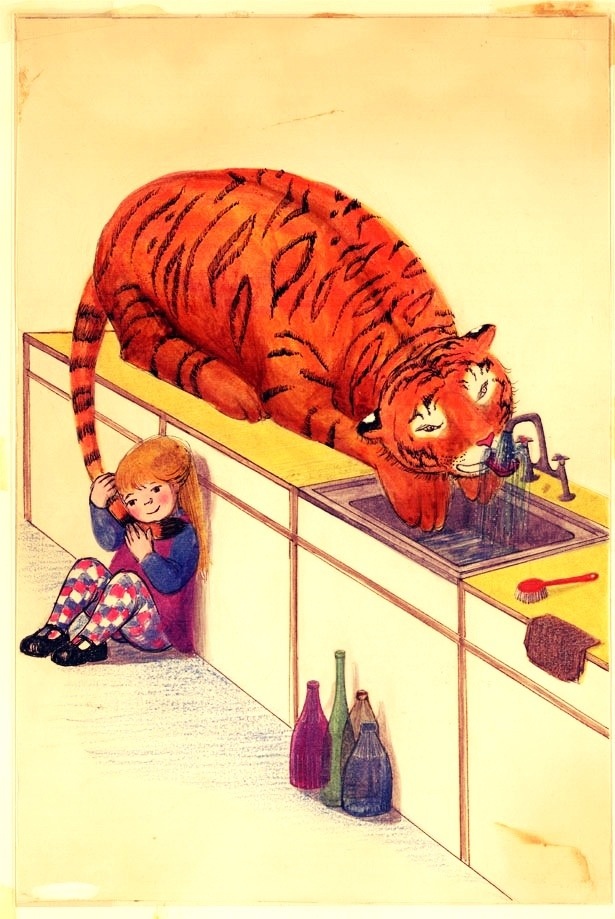
I doubt we could even explain, really, why it is so loved. Was it the calmness of Sophie in being met by a normally ferocious beast? Was it the casual cheek of the tiger eating everything, drinking everything (even the contents of the tap!) and then sodding off? Was it the unquestioning complicity of the mother; her openness to the unexpected? Was it the father coming home in his traditional English hat, finding he had no tea, and coming up with the cracking solution to go to the caff for sausage and chips instead? Was it the inexplicable trumpet the tiger is playing on the final page, the letters G O O D B Y E wisping out of the end of the horn?
Was it something in the ordinary home greeting an extraordinary visitor; the juxtaposition of reality and magic that so captured the world?

I wonder if the Booker prize winner The Luminaries, with its 832 pages, will have such a loyal following forty years from now.

Stories are in our blood, our hearts, our minds, memories, imaginations, dreams, they are coursing through our sub-conscious. They are in the chats we have, the looks we give, the gossip we hear, the things we ignore. They shape us. We make our own, tell our own. We want to hear them, we swap them. We pay to be entertained by them in a staggering array of growing mediums. No hour of our day is without its story – even alone in a long bath or out walking or filling our basket in an empty supermarket, we are followed internally by snatches of story – true or imaginary – the filigrees of our amazing brains whirring away doing so much more than mechanising our day’s survival. If you see a young homeless person sitting beneath an ATM and you walk away to another bank, you are writing your own story – you paint an instant picture of them (their story), you choose your actions based on the stimulus (your story). If you pick up a dropped glove and place it on a railing for someone to find, if you ignore the doorbell, if you have an unexplained hankering to go to Papua New Guinea… They’re all little parts in little stories that could go anywhere.

I haven’t watched the programme about the nice lady who wrote The Tiger Who Came To Tea yet. Maybe I don’t want to know about Judith Kerr – her life, how she wrote, what aspects of her truth hide beneath the cloak of fiction in her stories.

Maybe I don’t want to spoil the magic. Maybe I still think the tiger might come back.
20131209-112705.jpg

The Vagabond Diaries – ‘Clarence Larchsap’

The Vagabond Diaries – stories of being human by Sadie Hasler accompanied live by M G Boulter & The Lucky Strikes – premiered in the Old Trunk theatre at Village Green Festival 2013.

The piece was read by actor David Streames.

Thursday, April 5th, 1922

This is the 47th year of my writing a diary every day. I would say I have written it religiously but there have been days, as we are all like to have, when I have not been all that religious. There have been days, as we are all like to have, when I might say I have written in poor reverence to the lord. I have had bad thoughts, I have cheeked people without their knowing, stolen small and large items according to need or want, have cast my eye too long on a raised skirt far more than a Christian man might, and I have cussed, but have always seen fit to scribble the badness out. My diary has more black lines than words. Some days are just great black lines, and now that I am in my 62nd year I cannot always remember what went there in the first place.

I feel a little like starting again. Writing a new date, that has never yet existed, of telling you, whoever you are – for who do we write to when we write a diary? I do not know – telling you, a you whom I do not know, who I am. If anyone ever knows such a thing.

I would start, I suppose, with my name. I could do that. I can and so I will. My name is Clarence Larchsap. I had a nickname once, but I forget what it was or who saw fit to give it me.

I suppose I might next tell you I was born in a little town in South Carolina. For I was. The name, I suppose, does not matter. Its topographical features, how I travelled around them and what I did within them matters not either. I could inform you of a great many biographical details, as people seem so set on doing, as though telling you things about themselves makes them exist a bit more, but I shall not.

Schooling, love, happy days and friendship, they didn’t last and mean little to me now. Parentage, even, those broken souls who forerun our own blighted journeys, that too has come to mean no more than a quick sigh and is not something I can stretch out to lay on the paper.

So why do I write, what do I store in these pages? I think I write to pass the time. If I did not write as I sat I would not know what to do. I cannot just be.

I suppose you might call me a man of few roots, a traveller, a vagrant, a vagabond.
I move about. People don’t tend to want a man with such a character to stick around. And so I keep moving. Having such an…anti-social proclivity does not invite your welcome in most places. People like their stuff to remain intact. Unburned. I try to respect that by not sticking around after I have reduced their property to cinders. Sometimes I will pass through without giving in to the calling of the match in my pocket, which always burns there even before it is struck. And sometimes I permit myself. Sometimes I plan it in detail, and sometimes I do not know I have done it until I stand there with the hard honest heat on my cheeks.

Was I set off at a state of unrest, born as I was during an earthquake? Did the noise and chaos of nature set itself thudding in my heart from the moment I burst out into the air? I don’t suppose to know. I know only one real thing. As soon as my eyes could flicker, as soon as my fingers could curl and pinch and reach towards the things I wanted, I was drawn to flame. I would disregard all toys and books, I would ignore all beauty and spectacle, if I could look instead at fire. Even a lamplight in its last juddering breath would hold my attention more than the desire-struck face of the most beautiful woman in the world. She is nothing next to it.

You might say I was an arsonist. I suppose most people would. But I do not think the word does justice to the sight of something reducing itself down to ash in the blinding searing heat of a man acting in the thrall of his own secret will – something condemned to nothing in the smallest of moments. The word says nothing of this, so I prefer to leave myself uncategorised.

Perhaps it is sickness. Perhaps it is a revenge against something I cannot remember from my past. Perhaps it is a struggle with myself, with the world, with God himself.

Dear Diary, I do not know or I would tell you. But I will say, with the candour you can stow in a diary – this most loyal of friends, silent as ash – I will say, as a final thing before I take my night-time’s perambulation around all that dry matter people build up, those frames for future fires – I will say, before I move on in the morning – nothing shines quite a light like a thing you have set aflame yourself. Simply put, between two friends, I just like burning stuff down.

SONG – ‘BEAST’ – THE LUCKY STRIKES

20130716-084150.jpg

The Hero Down The Hall

“AW! REMEMBER WHEN YOU HAD NITS? YOUR HEAD STANK!” was the way I was greeted by a family friend last week. I’d already had “Remember when ‘uncle’ Clive bit your bum?” (Er, yes. Yes I do. EVERY NIGHT AS I WANDER THE DARK ABYSS OF THE SOUL.) and “I’m getting ruddy sick of seeing your face in the paper” (Thanks. Well…be thankful it’s not my bum, I guess.), so a loving reminder of my pre-pubescent scalp infestation was a nice distraction. (Sometimes I actually yearn for the yanking of that tiny comb.)

My mother, not usually one for such unnecessary displays, decided to have a birthday. She stuffed a Portuguese restaurant so full of her nearest and dearest that I spent the first hour or so utterly overwhelmed and not knowing who to talk to. I even felt that thing that surprises me from time to time; shyness.

Then I saw my lovely cousins Michael and Sammy, laughing at the end of the long table. I scooched down to sit with them, and even though I rarely see them, felt instantly comfortable. We still had the same playful ease that comes from having been kids together.

We were all born in East London. My family moved when I was three to Leicester, and Michael and Sammy, and their brother Sean and sister Emma, all stayed and grew up there. They were like gods to me. They were everything I wanted to become, but I could never quite catch up.

Michael came to live with us in Leicester for a bit when I was little and became like a brother; the proudly flatulent hero down the hall. I would run to his room, throw myself like a bed tobogganist onto his belly and make him terrify me with tales of ‘Monsters and Demons’. I’d wriggle and scream but never once actually want to escape. He’d sing me ‘Ding dong bell, Pussy’s in the well. Who put her in? Little Johnny Flynn.” with a knowing malevolence that delighted me. (Songs about drowning cats were what I lived for back there in the formative jungle of ’85.)

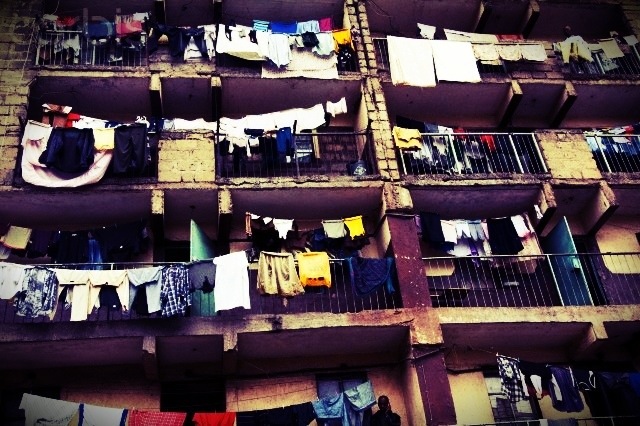
My cousins joked about what I might be like now if I’d stayed in Hackney. We decided I would probably be a self-appointed warden of a notorious tower block, a well-meaning but potty-mouthed avenger of knife crime or something. Michael and Sammy laughed, but I could actually picture my Alsatian. His name was Atticus and he wore a patch. I probably would have got shot in the face for talking to my plants and died hanging out of my tenth storey window with my wet bedsheets flapping in the smog. (Or been a reasonably-priced prostitute upon whose boobs you could have a good cry and then I’d give you a biscuit.)

I often wonder, actually, what my life might have been like, in Hackney, in Leicester – if things had somehow wandered their way into being…different.

But being there at the party with my cousins, drinking beer and laughing, and seeing my mum warmly watching over at us like her many homes had aligned, our current circumstances sort of didn’t matter. We almost weren’t who we are, but who we were together, before life beckoned us away.

I’ve never really thought about how my cousins shaped who I am. Sometimes we don’t pause to credit people, do we? But they were where I started. They were the steps ahead; could read, write, play out, drink hot tea, swear, all before I could. Heroes.

And Michael taught me to love stories. It’s what my life rotates around now – dreaming and writing and playing in stories. And when someone has given you that, they’ll always be in your life, whether you see them often or not.

20130325-101517.jpg